How to Spell Donut, Plaque, Omelette & Balloon: Correct Spellings
From American Simplification to French Heritage and British Standards: The Definitive Transatlantic Guide to Doughnuts, Omelets, Plaques, Balloons, and Gray vs. Grey

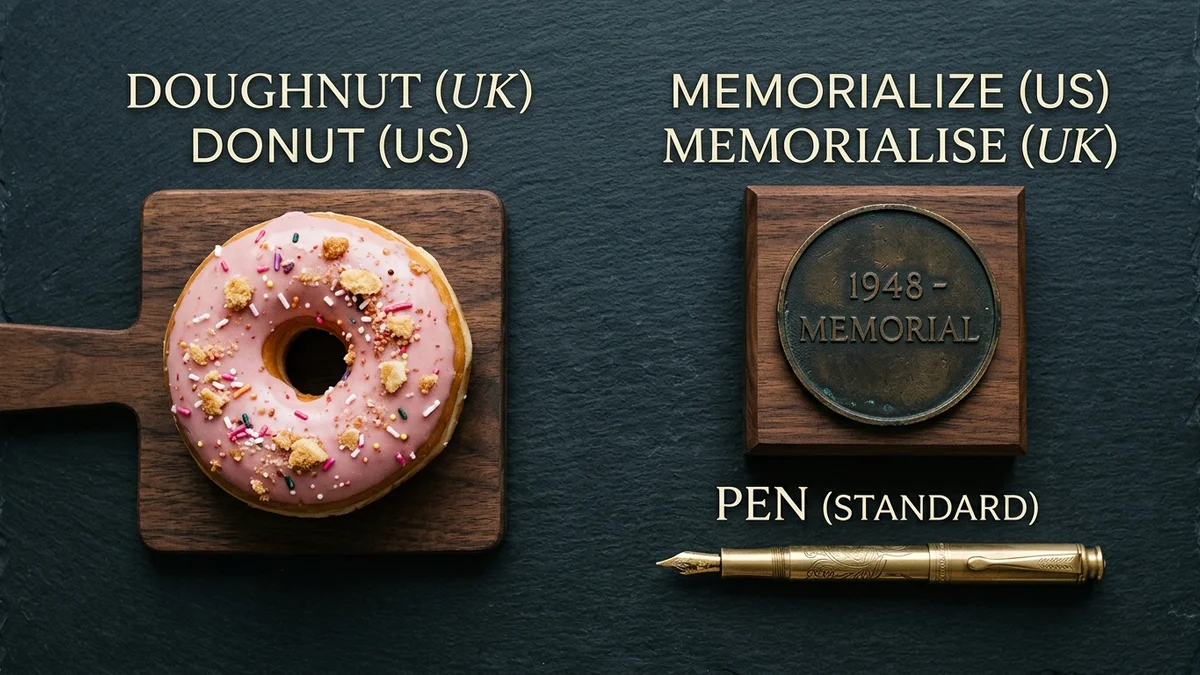
- Doughnut is the traditional, formal spelling worldwide; Donut is a simplified American commercial variant popularized in the 1950s that is now accepted in informal writing and culinary branding.
- Plaque (P-L-A-Q-U-E) is the only correct spelling in both British and American English; spelling it placque is a common orthographic error.
- Omelet is the preferred American spelling, while Omelette is the standard in British, Canadian, Australian, and French English.
- Balloon requires two "L"s and two "O"s (B-A-L-L-O-O-N), originating from the Italian pallone (large ball).
- Gray is the American standard (A for America), whereas Grey is the British and Commonwealth standard (E for England), with exceptions for proper nouns like Earl Grey and Greyhound.
The Transatlantic Divide: Why English Spellings Diverge
If you have ever drafted an international marketing campaign, published an editorial whitepaper, or reviewed an enterprise brand identity guide, you have encountered the divergence between American English and British / Commonwealth standards.
Much of this divergence was deliberate. In 1806, American lexicographer Noah Webster published his revolutionary dictionary with the explicit mission of reforming English spelling—stripping extraneous French and British letters (colour became color, theatre became theater, and programme became program).
However, some words resisted total uniformity, creating persistent questions for modern writers. Here is the authoritative breakdown of the five most widely queried words across search engines today.
1. How to Spell "Donut" vs. "Doughnut"
Both spellings refer to the same fried ring of sweet dough, but they belong to different stylistic registers.
The Traditional Standard: D-O-U-G-H-N-U-T
The word first appeared in print in 1809 in Washington Irving's A History of New York, describing "balls of sweetened dough, fried in hog's fat, and called doughnuts." The etymology was literal: a ball or "nut" made of dough.
Major style guides—including The Chicago Manual of Style, The Associated Press (AP) Stylebook, and The Oxford English Dictionary—continue to prescribe doughnut as the formal, preferred spelling.
The Commercial Variant: D-O-N-U-T
The simplified spelling donut emerged in the late 19th century but exploded into global ubiquity in 1950 when Dunkin' Donuts was founded. Today, donut is fully accepted in modern American dictionaries as an alternate spelling, especially in commercial marketing, food menus, and casual digital culture.
Summary Rule:
• In formal journalism, book publishing, and British/Commonwealth English: Use doughnut.
• In consumer marketing, informal blogs, and American commercial branding: donut is widely accepted.
2. How to Spell "Plaque" (P-L-A-Q-U-E)
The only correct spelling is P-L-A-Q-U-E.
The Common Error: Placque
Adding a "c" before the "q" (placque) is a pervasive misspelling. Writers assume that because the word sounds like plack, it requires a "c-k" or "c-q" phonetic blend.
The Etymology:
Plaque was borrowed directly into English from French in the early 19th century (from Middle Dutch placke, meaning a small disk or coin). English preserved the French spelling ending in -que.
Dual Meanings in Professional Life:
1. Commemorative Award: An ornamental bronze, wood, or acrylic plate awarded for achievement: "She received a commemorative leadership plaque at the annual gala."
2. Medical / Dental: A sticky film of bacteria on teeth or a buildup of fatty deposits in arteries: "Regular flossing prevents arterial and dental plaque."
3. How to Spell "Omelette" vs. "Omelet"
Both spellings are correct, divided cleanly along geographical borders:
• Omelet (O-M-E-L-E-T) is the standard in American English. Noah Webster trimmed the final "-te" to streamline the spelling.
• Omelette (O-M-E-L-E-T-T-E) is the standard in British English, Canadian English, Australian English, and French.
In American fine-dining menus, chefs frequently choose omelette to impart an air of classic French culinary sophistication, but standard American publications (such as the New York Times) default to omelet.
4. How to Spell "Balloon" (B-A-L-L-O-O-N)
The correct spelling is B-A-L-L-O-O-N — featuring double L and double O.
Common Errors: Baloon, Ballon
Baloon (single L) is an incorrect phonetic guess. Ballon (single O) is the French and German spelling for a ball or hot-air sphere, but incorrect in English.
The Linguistic Lineage:
The word entered English via French ballon from the Italian pallone, an augmentative of palla (ball). When English naturalized the word in the late 17th century, it anglicized the ending to the double "oo" sound to represent the long /uː/ vowel.
Memory Trick:
"A balloon is filled with double air: it has two L's and two O's floating inside."
5. Is It "Gray" or "Grey" for the Color?
Both spellings refer to the neutral intermediate color between black and white. The rule for choosing between them is one of the easiest mnemonics in the English language:
• grAy is the preferred spelling in America (A = America).
• grEy is the preferred spelling in England and Commonwealth nations (E = England).
Important Exceptions to the Geographic Rule:
Proper nouns and trademarked terms maintain their fixed historical spelling regardless of where you live:
• Earl Grey Tea: Always spelled with an E (named after British Prime Minister Charles Grey).
• Greyhound Dog & Bus Lines: Always spelled with an E (derived from Old English grīghund).
• Gray (Unit of Radiation): The scientific SI unit of absorbed ionizing radiation is always spelled gray (named after British physicist Louis Harold Gray).
Noah Webster & Theodore Roosevelt: The Simplified Spelling Crusade
The story of why Americans write donut and omelet while Londoners write doughnut and omelette leads directly to President Theodore Roosevelt and industrial titan Andrew Carnegie.
In 1906, Carnegie funded the Simplified Spelling Board, enlisting luminaries like Mark Twain, Supreme Court Justice David Brewer, and Columbia University professors to strip redundant silent letters from 300 common English words.
President Roosevelt was so enamored with the idea of making English more democratic and easier for immigrants to learn that he issued an executive order requiring the United States Government Printing Office to adopt the simplified spellings immediately.
Roosevelt’s list included words like altho (although), thru (through), and doughnut simplified toward donut. However, Congress erupted in fury, accusing the President of executive overreach and literary vandalism. Congress passed a resolution mandating that traditional spellings be maintained in all federal statutes, forcing Roosevelt to withdraw his executive order.
Despite the political defeat, American commercial culture enthusiastically embraced simplified variants that were shorter, punchier, and cheaper to print on roadside neon billboards.
Transatlantic Localization: Checklist for Global Marketing & Copywriting
When preparing corporate websites, client pitch decks, or whitepapers for international audiences, follow this cross-border localization checklist:
1. Establish a Single Regional Locale per Document
Never mix American and British conventions within the same publication. If you choose American English (en-US), use gray, omelet, color, and analyze. If you choose British English (en-GB), maintain grey, omelette, colour, and analyse.
2. Configure CMS & Spellcheck Locale Dictionaries
Ensure your content management system (WordPress, Contentful, Next.js i18n) routes readers based on geographical HTTP headers and verifies that automated QA linters validate localized dictionaries.
3. Handle Dual-Market Brand Names with Care
When referencing global products, preserve original corporate nomenclature. For example, write "Dunkin' Donuts" even when publishing in the UK, but write "The bakery sold traditional artisan doughnuts" in the descriptive editorial body.
Cultural Etymology: From Dutch Olykoeks to Versailles Balloons
The peculiar spellings of food and domestic objects reflect centuries of international migration, trade conquests, and technological invention:
1. The Dutch Roots of the Doughnut
In the 17th century, Dutch settlers in New Amsterdam (modern New York City) brought recipes for olykoeks ("oil cakes")—balls of sweetened yeast dough deep-fried in pork fat. Because the dense centers often remained raw while the exterior browned, cooks began stuffing nuts, apples, or dried fruits in the middle, giving birth to the literal term dough-nut. The iconic ring shape with a center hole was invented in 1847 by an American teenage sailor named Hanson Gregory, who punched out the center using a round tin pepper box.
2. From French Alemelle to the Modern Omelette
The culinary term omelette underwent radical phonetic transformations across five centuries of French haute cuisine. It originated in the Latin lamella (thin plate or metal blade), transformed into Old French alemelle, mutated into alumelle, and was eventually recorded in 1393 in Le Ménagier de Paris as omelette. When British and American cooks imported the dish, British writers preserved the elegant French suffix, while Noah Webster streamlined it into omelet.
3. The Aerostatic Revolution: The Montgolfier Balloon
The word balloon took on worldwide fame on September 19, 1783, when the Montgolfier brothers launched the first hot-air balloon carrying living passengers (a sheep, a duck, and a rooster) in the presence of King Louis XVI at the Palace of Versailles. English writers rapidly adapted the French term ballon into balloon, capturing the imagination of scientists, military strategists, and Victorian novelists.
Intellectual Property: When Misspelled Words Become Billion-Dollar Brands
In commercial intellectual property (IP) law, generic words cannot be trademarked. You cannot register a trademark for "Fried Doughnut" or "Chocolate Ice Cream" because competitors must be able to describe their products.
To bypass this legal restriction, corporate founders frequently invent deliberate phonetic misspellings, creating powerful protectable trademarks:
• Dunkin' Donuts (1950): Standardizing donut enabled Bill Rosenberg to build a globally distinct, protectable retail identity.
• Krispy Kreme (1937): Swapping "Crispy Cream" into double "K"s created one of the most legally defensible food trademarks in American retail history.
• Froot Loops (1963): Because Kellogg's breakfast cereal contained no actual fruit juice, US food and drug regulatory labeling laws prohibited calling it "Fruit Loops." Misspelling the name as Froot satisfied federal regulators while turning double "O"s into playful cereal-shaped loops.
• Lite Beer (Miller Lite): Miller trademarked the phonetic variant Lite in the 1970s, sparking decades of landmark trademark litigation regarding consumer perception and phonetic distinctiveness.
Master Reference Matrix: American vs. British & Global Standards
Use this quick-reference guide when writing copy for global audiences:
| Word / Term | American English Standard | British / Commonwealth Standard | Frequent Misspelling |
| :--- | :--- | :--- | :--- |
| Fried Pastry | Donut (informal) / Doughnut (formal) | Doughnut (strictly) | dounut, doughnot |
| Commemorative Plate | Plaque | Plaque | placque, plaquee |
| Egg Dish | Omelet | Omelette | omlet, omlette |
| Inflatable Sphere | Balloon | Balloon | baloon, ballon |
| Neutral Shade | Gray | Grey | graey |
| Color / Colour | Color | Colour | colur |
| Theater / Theatre | Theater | Theatre | theature |
| Center / Centre | Center | Centre | centur |
| Organize / Organise | Organize (-ize) | Organise (-ise) or Organize | organice |
Frequently Asked Questions
Which is more correct: donut or doughnut?
"Doughnut" is the older, traditional, and formally correct spelling recognized by all major style guides. "Donut" is a popular simplified American variant that is widely accepted in commercial branding, food menus, and informal writing.
How do you spell plaque correctly?
"Plaque" is spelled P-L-A-Q-U-E in both American and British English. The spelling "placque" is an incorrect misspelling.
Is it omelet or omelette in Canada?
Canada generally follows British/French conventions and prefers "omelette," although "omelet" is understood due to American media influence.
How do you remember whether to use gray or grey?
Remember the mnemonic: grAy for America (A = America) and grEy for England (E = England).
Why does balloon have two l's and two o's?
"Balloon" was derived from the Italian "pallone." English adopted the double "l" from the Italian root and anglicized the vowel ending into "oon" to reflect the long /uː/ pronunciation.
Is "doughnut" capitalized?
No, "doughnut" (or "donut") is a common noun and should not be capitalized unless it begins a sentence or appears as part of a proper trademark like "Dunkin' Donuts".
Is "grey" acceptable in American English?
Yes, major American dictionaries list "grey" as an accepted variant of "gray," although "gray" appears roughly twenty times more frequently in American publications.
What is the plural of plaque?
The plural form is plaques (spelled P-L-A-Q-U-E-S). When referencing dental or arterial buildup, plaque is typically treated as a non-count mass noun, whereas commemorative awards are countable.
Why did Dunkin’ Donuts drop "Donuts" from its brand name?
In 2018, the corporate entity rebranded to simply "Dunkin’" to emphasize its expansion into premium iced espresso drinks, cold brews, teas, and breakfast sandwiches, positioning the brand to compete directly with Starbucks.
Claire Montgomery is a senior human resources executive and workplace communications analyst with 16 years of enterprise leadership experience guiding corporate culture, internal diplomacy, and team sentiment.
Further Recommended Readings from Our Desks
Pros of a Business Partnership: 8 Big Advantages, Types & Agreement Tips
An executive masterclass on business partnerships: 8 foundational strategic advantages, legal entity structures (GP, LP, LLP, LLC), partnership agreement anatomy, and dispute-proofing protocols.
Early Education Franchise Guide: Startup Costs, Top Childcare Brands & ROI
The definitive institutional guide to early childhood education and preschool franchises: Item 7 real estate startup costs, top brand financial metrics, state regulatory ratios, and franchisee ROI.
Youth Entrepreneurship Support Programme: Grants, Mentorship & Funding for Young Founders
The ultimate guide to youth entrepreneurship support programmes: non-dilutive grant capital, top global accelerators, elite mentorship frameworks, and application strategies for founders under 30.