
Swiss FADP vs. EU GDPR for AI Services: Key Provisions, Critical Differences & Comprehensive Comparison
A definitive statutory analysis comparing Switzerland’s revised Federal Act on Data Protection (nFADP) with the EU GDPR for enterprise AI providers, generative model developers, and cloud software platforms.

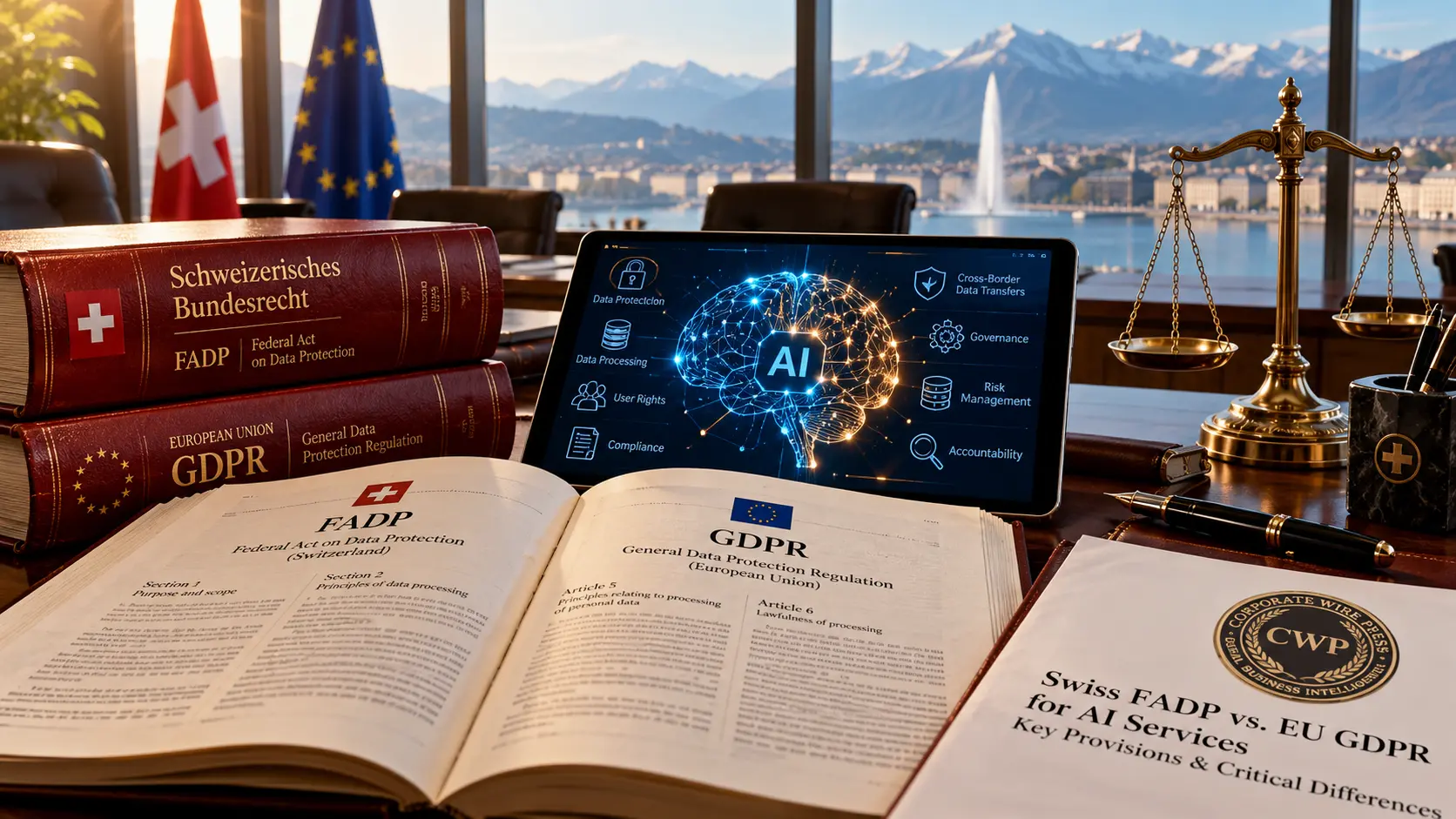
- Scope of Protection Harmonization: The revised Swiss Federal Act on Data Protection (nFADP), effective September 1, 2023, eliminated protection for legal entities, aligning with the EU GDPR to protect strictly natural persons.
- Divergent Philosophy on Processing Legality: While GDPR Article 6 establishes a general prohibition on processing unless justified by a designated legal basis, Swiss nFADP operates on a principle-based framework derived from civil personality rights where processing by private actors is fundamentally lawful unless it breaches statutory principles without justification.
- Statutory High-Risk Profiling: Swiss nFADP codifies a distinct legal standard for "high-risk profiling" (profiling that creates a complete personality profile), requiring explicit consent from private controllers only if personality rights are infringed, contrasting with GDPR Article 22’s regime on automated individual decision-making.
- Enforcement Architecture: GDPR penalizes corporate entities with administrative fines up to €20M or 4% of global annual turnover, whereas Swiss nFADP imposes direct criminal fines up to CHF 250,000 on responsible individuals (directors, compliance officers) who act intentionally.
- Governance & AI Impact Assessments: Both frameworks mandate Data Protection Impact Assessments (DPIAs) for high-risk AI deployments, but Swiss law features flexible Data Protection Advisor (DPO) designations and pragmatic exemptions for Swiss-based AI developers.
Scope of Protection: Personal Data & B2B Legal Entities (Swiss FADP vs. GDPR Natural Persons)
One of the most consequential historical distinctions between Swiss data protection law and European data protection law was Switzerland’s historic protection of legal entities. Under the original 1992 Swiss Data Protection Act, company data—such as financial sheets, commercial contracts, and enterprise registries—was classified as "personal data," requiring enterprise AI vendors to navigate data privacy restrictions even when processing pure B2B datasets.
With the enactment of the revised nFADP on September 1, 2023, the Swiss Federal Assembly formally repealed the protection of legal persons under Article 5(a) nFADP. Switzerland’s definition of "personal data" (Personendaten / données personnelles) is now strictly harmonized with GDPR Article 4(1): it exclusively encompasses information relating to an identified or identifiable natural person (natürliche Person / personne physique).
For enterprise AI vendors building B2B SaaS applications, corporate knowledge graphs, or commercial code assistants in Zurich, Geneva, or Zug, this statutory alignment eliminated massive operational friction. Proprietary enterprise documents, company balance sheets, corporate email domains, and institutional trade registries can now be ingested, tokenized, and processed without triggering data privacy obligations—provided that individual employee names, direct personal identifiers, or identifiable biometric artifacts are systematically excised.
High-Risk AI Profiling: Swiss "High-Risk Profiling" vs. GDPR Article 22 Automated Decisions
Where the two legal architectures fundamentally diverge is in their statutory treatment of algorithmic profiling and automated decision-making. As machine learning models increasingly automate behavioral scoring, fraud detection, credit underwriting, and candidate screening, compliance teams must parse distinct statutory terminology.
Under GDPR Article 4(4), "profiling" is defined as any form of automated processing of personal data evaluating personal aspects relating to a natural person. GDPR does not create separate sub-tiers of profiling per se; instead, GDPR Article 22 governs "automated individual decision-making, including profiling," establishing a general prohibition on decisions based solely on automated processing that produce legal effects or similarly significant effects on the individual, subject to narrow statutory exceptions (explicit consent, contractual necessity, or statutory authorization).
In contrast, Swiss nFADP establishes a unique, two-tiered statutory categorization for algorithmic analytics in Article 5(f) nFADP:
1. Standard Profiling (Profilierung): Any automated processing of personal data consisting of using that data to assess certain personal aspects of a natural person, particularly analyzing or predicting performance at work, economic situation, health, personal preferences, interests, reliability, behavior, location, or movements.
2. High-Risk Profiling (Profilierung mit hohem Risiko): Profiling that poses a significant risk to the personality or fundamental rights of the data subject by pairing data that allows an assessment of essential aspects of the personality of a natural person. This occurs when an AI engine correlates disparate data vectors (e.g., browsing history, geolocation, purchase history, and biometric cadence) to synthesize a comprehensive psychological or behavioral composite of an individual.
The operational consequence under Swiss law is profound: pursuant to Article 6(6) nFADP, private controllers deploying AI engines that perform high-risk profiling require express consent (ausdrückliche Einwilligung) only if the processing infringes upon the personality rights of the individual without a legal justification ground. Furthermore, federal bodies (Bundesorgane) deploying high-risk profiling systems are subject to strict statutory basis requirements under Article 34 nFADP.
Legal Grounds for AI Training Data: Swiss Principle-Based Legality vs. GDPR Article 6 Legal Bases
Training foundational AI models—such as Large Language Models (LLMs), multimodal vision transformers, and speech synthesis algorithms—requires scraping or ingesting vast corpora of textual, visual, and audio data, much of which contains embedded personal information. Here, the underlying jurisprudence of Switzerland contrasts sharply with that of the European Union.
The EU GDPR is constructed on a foundational principle of prohibition (Verbotsprinzip): all processing of personal data is unlawful unless the data controller can establish at least one of the six exhaustive legal bases enumerated in GDPR Article 6(1) (Consent, Performance of a Contract, Legal Obligation, Vital Interests, Public Interest Task, or Legitimate Interests). For frontier AI labs in the EU, relying on "Legitimate Interests" (Article 6(1)(f)) for training foundation models has triggered intense regulatory scrutiny from European data protection authorities, particularly regarding whether legitimate interests override data subjects’ rights, and how the right to object (Article 21) can be implemented mathematically within immutable neural network weights.
Switzerland’s nFADP, grounded in the Swiss Civil Code (Zivilgesetzbuch, ZGB Art. 28 protecting personal integrity), takes an entirely different philosophical approach: processing by private parties (private Personen) is fundamentally permitted provided that general data processing principles are scrupulously observed. Under Article 6 nFADP, these principles mandate that data must be:
• Processed lawfully (Rechtmässigkeit) and in good faith (Treu und Glauben); • Commensurate and proportionate to the intended purpose (Verhältnismässigkeit); • Collected only for specific, recognizable purposes and processed compatibly with those purposes (Zweckbindung); • Accurate and kept up to date (Richtigkeit); and • Processed transparently, ensuring the data subject can recognize that processing occurs.
Under Swiss law, an AI developer does not need to identify a rigid GDPR-style legal basis from day one. An explicit justification ground (Rechtfertigungsgrund under Article 30 nFADP—such as consent, an overriding private interest, an overriding public interest, or statutory authorization) is only legally required if the processing constitutes a personality infringement (Persönlichkeitsverletzung), such as processing against the express will of the individual, processing sensitive personal data without safeguards, or violating the core principle of proportionality.
Consequently, Swiss-based AI developers enjoy greater structural flexibility when developing internal machine learning algorithms, provided they maintain rigorous data minimization and transparency protocols.
Quick Reference Matrix: Swiss nFADP vs. EU GDPR for Artificial Intelligence Systems
To assist corporate counsel, AI product managers, and enterprise compliance auditors, the following statutory matrix compares the critical provisions governing AI systems across both jurisdictions.
| Regulatory Dimension | Swiss Revised FADP (nFADP 2023) | EU GDPR (Regulation 2016/679) | Operational Impact on AI Providers |
|---|---|---|---|
| Core Scope | Natural persons exclusively (Art. 5(a)). Legal persons excluded since Sept 1, 2023. | Natural persons exclusively (Art. 4(1)). | Harmonized. Pure B2B enterprise company data can be processed without data privacy constraints. |
| Processing Philosophy | Permissive principle-based framework (Art. 6). Justification only needed if personality rights are breached (Art. 30). | Strict prohibition unless authorized by one of 6 exhaustive legal bases (Art. 6(1)). | Swiss developers possess greater agility for model training under general good faith and proportionality principles. |
| Algorithmic Profiling | Distinguishes between standard profiling and "High-Risk Profiling" (Arts. 5(f), 6(6)). | Defines profiling generally (Art. 4(4)); restricts solely automated decisions with legal effects (Art. 22). | AI models creating deep behavioral composites trigger explicit consent under Swiss law if personality rights are at stake. |
| Automated Decision Explanations | Data subject must be informed of automated individual decisions; right to request human review (Art. 21). | Right not to be subject to automated decisions; right to human intervention and explanation (Art. 22). | Both frameworks require algorithmic explainability and human-in-the-loop escalation paths for high-impact outputs. |
| DPIA Mandate | Mandatory for processing posing high risk to personality or fundamental rights (Art. 22). | Mandatory for high-risk processing, systematic profiling, and extensive monitoring (Art. 35). | Compulsory for generative AI, automated scoring, facial recognition, and biometric AI inference across both regimes. |
| DPO / Advisor Role | Data Protection Advisor (Datenschutzberater) is voluntary for private entities (Art. 10). | Data Protection Officer (DPO) is mandatory for core systematic monitoring or sensitive data (Art. 37). | Appointing a Swiss Advisor provides legal relief: exemption from mandatory FODPC consultation on unmitigated DPIAs. |
| Record of Processing (RoPA) | Exemption for companies with fewer than 250 employees unless high-risk processing occurs (Art. 12). | Exemption for companies under 250 employees unless processing is non-occasional or high-risk (Art. 30(5)). | AI companies rarely qualify for the SME exemption under either law because automated profiling is deemed inherently high-risk. |
| Cross-Border Transfers | Adequacy list published by Federal Council. Standard Contractual Clauses (SCCs) require Swiss Addendum. | Adequacy decisions by European Commission. Standard Contractual Clauses (SCCs) require Transfer Impact Assessment. | EU transfers to Switzerland are mutually recognized; transferring Swiss data outside the EEA requires the Swiss SCC Addendum. |
| Sanctions & Liability | Criminal fines up to CHF 250,000 imposed on individual executives for intentional violations (Arts. 60–66). | Administrative fines up to €20,000,000 or 4% of global turnover against the enterprise entity (Art. 83). | Swiss law targets the personal liability of C-suite officers and directors, creating severe personal accountability. |
Data Protection Impact Assessments (DPIAs) for Generative AI & Large Language Models
Both regulatory regimes establish formal obligations to conduct Data Protection Impact Assessments (DPIAs—known in German as Datenschutz-Folgenabschätzung or DSFA) before initiating data processing that is likely to result in a high risk to the fundamental rights or personality of data subjects.
Under Swiss nFADP Article 22, a controller must conduct a DPIA whenever the processing operations pose a high risk to the data subject's personality or fundamental rights, particularly when utilizing new technologies (such as generative neural networks, retrieval-augmented generation (RAG) pipelines, or autonomous agentic workflows). The statute explicitly presumes high risk when extensive processing of sensitive personal data or extensive high-risk profiling is undertaken.
A compliant Swiss AI DPIA must include:
1. A granular technical description of the planned processing, including model architecture, training data provenance, embedding dimensions, and temperature parameters; 2. An assessment of risks to the personality rights of data subjects (e.g., algorithmic hallucination, model inversion attacks, unauthorized biometric extraction, or demographic bias); 3. Measures to eliminate or mitigate identified risks (e.g., differential privacy, zero-data retention agreements with model hosting APIs, synthetic data substitution, and post-processing safety filters).
Crucially, if the DPIA reveals that high risks persist despite mitigation measures, Swiss law mandates that the controller must consult the Federal Data Protection and Information Commissioner (FODPC / EDÖB / PFPDT) pursuant to Article 23 nFADP. However, Article 23(4) nFADP contains a vital corporate relief clause: private controllers are exempt from consulting the Federal Commissioner if they have appointed an independent Data Protection Advisor (Datenschutzberater) pursuant to Article 10 nFADP and consulted them on the assessment.
Cross-Border Data Transfers: Swiss Transfer Rules, Adequacy Decisions & Standard Contractual Clauses
Because modern AI platforms routinely utilize globally distributed cloud GPU clusters (such as AWS, Microsoft Azure, and Google Cloud infrastructure located across Frankfurt, Zurich, Dublin, and Northern Virginia), cross-border data transfer rules represent an urgent compliance consideration.
Under Article 16 nFADP, personal data may be transferred abroad only if the recipient state provides an adequate level of data protection. Unlike the European Union, where the European Commission issues adequacy decisions, in Switzerland, the Federal Council (Bundesrat) maintains its own binding statutory list of countries with adequate protection (published in Annex 1 to the Data Protection Ordinance, DPO / VDS / OLPD).
Crucially for Swiss-EU commerce, the Federal Council recognizes all EU and EEA member states as adequate. Reciprocally, in January 2024, the European Commission officially renewed its adequacy decision for Switzerland under GDPR Article 45, confirming that data can flow seamlessly between the European Union and Switzerland without supplemental transfer mechanisms.
However, when an AI platform transfers data from Switzerland to the United States or other non-adequate jurisdictions, controllers must implement appropriate safeguards under Article 16(2) nFADP:
• Standard Contractual Clauses (SCCs): Switzerland officially recognizes the European Commission’s Standard Contractual Clauses (Modular SCCs). However, companies cannot simply execute vanilla EU SCCs. The Federal Data Protection and Information Commissioner (FODPC) requires a mandatory "Swiss Addendum" (or Swiss jurisdictional adaptations) that explicitly references the Swiss nFADP, recognizes the supervisory authority of the FODPC, and ensures that Swiss data subjects can enforce their rights before Swiss courts.
• Swiss-U.S. Data Privacy Framework: In January 2024, the Swiss Federal Council approved the principle of the Swiss-U.S. Data Privacy Framework, which entered into force in September 2024, enabling certified U.S. commercial entities to receive Swiss personal data without executing standalone SCCs, mirroring the EU-U.S. DPF mechanism.
Governance Differences: Criminal Sanctions on Individuals vs. Corporate Turnover Fines
The most striking divergence between the European and Swiss data privacy regimes lies in their punitive enforcement architectures. For corporate executives, understanding this distinction is vital to risk management and organizational governance.
The European Union’s GDPR is built around massive administrative fines levied directly against the corporate balance sheet. Under GDPR Article 83, national supervisory authorities can impose administrative penalties of up to €10,000,000 (or 2% of total worldwide annual turnover) for organizational infractions, and up to €20,000,000 (or 4% of total worldwide annual turnover) for core violations of processing principles, data subject rights, or cross-border transfer requirements.
Switzerland rejected this corporate administrative fine model. Instead, Articles 60 through 66 nFADP establish a framework of direct criminal penalties (Strafbestimmungen) punishable by criminal fines of up to CHF 250,000. Most significantly, these criminal fines are not levied against the corporate balance sheet; they are imposed directly on the natural persons who committed the intentional violation—specifically targeting company directors, C-suite officers, general counsel, chief information security officers, or designated project managers.
Statutory offenses triggering criminal liability under Swiss law include:
1. Intentional breach of information duties (failure to disclose AI automated processing under Article 19 nFADP); 2. Intentional failure to provide complete or accurate information upon a data subject access request (Article 25 nFADP); 3. Intentional transfer of personal data abroad in violation of Article 16 nFADP without an adequacy decision or appropriate safeguards; 4. Intentional violation of professional secrecy duties (Berufsgeheimnis) under Article 62 nFADP; 5. Intentional failure to comply with a binding order issued by the Federal Commissioner (Article 63 nFADP).
While the Swiss statute limits criminal liability to intentional conduct (Vorsatz—meaning negligence or simple carelessness is not punishable), intentional non-compliance or deliberate regulatory evasion exposes senior executive leadership to personal criminal records and individual financial sanctions.
Algorithmic Transparency & Rights of Data Subjects: Access, Explainability & Human Intervention
As artificial intelligence systems ingest personal data and deliver automated recommendations, classifications, and predictive scores, both Swiss nFADP and EU GDPR establish comprehensive transparency and subject rights frameworks.
Under Swiss nFADP Article 19, the controller must inform the data subject in advance regarding the collection of personal data. When personal data is ingested into an automated decision-making pipeline, Article 21 nFADP explicitly mandates that the controller must inform the data subject of any decision taken exclusively on the basis of automated data processing that has a legal effect on them or significantly affects them (automatisierte Einzelentscheidung / décision individuelle automatisée).
Upon request, the data subject has the right under Article 21(2) nFADP to:
• Express their point of view regarding the automated output; • Demand that the automated decision be reviewed by a human being (Überprüfung durch eine natürliche Person); and • Receive meaningful information regarding the underlying algorithmic logic and parameters utilized to reach the decision.
Similarly, GDPR Articles 13–15 and 22 grant individuals the right to obtain meaningful information about the logic involved in automated decision-making and the significance and envisaged consequences of such processing, alongside the right to human intervention. AI software providers operating in Switzerland and the EU must therefore build auditable explainability interfaces and human escalation review mechanisms directly into their model deployment architectures.
Frequently Asked Questions: Swiss nFADP vs. EU GDPR for Artificial Intelligence
The following inquiries represent the most common operational and regulatory questions encountered by cross-border legal and technical teams.
1. Does full GDPR compliance guarantee compliance with the Swiss nFADP?
No. While an enterprise that complies with GDPR has satisfied approximately 85% of Swiss nFADP obligations, critical Swiss-specific requirements remain. These include adding the mandatory Swiss jurisdictional addendum to Standard Contractual Clauses (SCCs), adhering to Swiss criminal liability standards for individual executives, updating privacy policies to reference the Federal Data Protection and Information Commissioner (FODPC), and evaluating whether algorithmic profiling constitutes Swiss "high-risk profiling."
2. Are legal entities still protected under the Swiss Data Protection Act in 2026?
No. The revised nFADP that took effect on September 1, 2023, completely removed legal entities from the definition of personal data. Personal data under Swiss law now exclusively refers to natural persons, harmonizing with GDPR. B2B enterprise datasets that contain no identifiable human information do not trigger Swiss data protection law.
3. Is appointing a Data Protection Officer (DPO) mandatory in Switzerland for AI companies?
No. Unlike GDPR Article 37, which mandates a DPO for entities conducting systematic monitoring or processing special category data at scale, Swiss nFADP Article 10 makes the appointment of a Data Protection Advisor (Datenschutzberater) voluntary for private entities. However, appointing a Swiss Advisor is highly advantageous: it exempts the enterprise from having to consult the Federal Commissioner if a Data Protection Impact Assessment (DPIA) demonstrates residual high risks.
4. How do penalties differ between GDPR and Swiss nFADP for AI violations?
GDPR imposes administrative corporate fines of up to €20M or 4% of annual global turnover directly against the enterprise. Swiss nFADP imposes criminal fines of up to CHF 250,000 directly against natural persons (individual executives, directors, or managers) who intentionally violate statutory transparency, cross-border transfer, or disclosure duties.
5. Can Swiss AI companies use EU Standard Contractual Clauses for international data transfers?
Yes, but with an essential modification. The Swiss Federal Data Protection and Information Commissioner (FODPC) officially recognizes the EU Standard Contractual Clauses (SCCs) provided that parties incorporate a Swiss Annex or Addendum. This addendum ensures that references to GDPR include the Swiss nFADP, the FODPC is designated as competent authority, and Swiss courts have jurisdiction to hear claims from Swiss data subjects.
Conclusion: Building a Unified Swiss-EU AI Compliance Architecture
Deploying enterprise artificial intelligence services across the Swiss-European corridor requires moving beyond superficial regulatory assumptions. While the European Union’s GDPR and Switzerland’s revised FADP share a common philosophical commitment to safeguarding fundamental human rights in the digital age, their statutory mechanics diverge in critical operational areas.
To achieve robust cross-border compliance, technology organizations should implement a unified data privacy architecture: conduct rigorous Data Protection Impact Assessments that address both GDPR Article 35 and Swiss Article 22, integrate algorithmic explainability and human escalation loops for automated decisions, execute EU Modular SCCs enhanced with the Swiss Jurisdictional Addendum, and ensure corporate leadership understands the personal criminal liability framework unique to Switzerland.
By proactively addressing these statutory nuances, AI innovators can leverage Switzerland’s world-class technological infrastructure, legal stability, and data privacy reputation while maintaining seamless interoperability with the wider European digital economy.
Julian Vance has spent 18 years counseling Fortune 500 AI platforms and multinational financial groups on compliance with Swiss FADP, EU GDPR, and cross-border data transfer mechanisms.
Further Recommended Readings from Our Desks
Swiss FADP vs. EU GDPR: Core Legal Differences, Principles & Requirements Explained
A foundational legal analysis examining the core philosophical doctrines, statutory principles, consent standards, and governance requirements that distinguish Swiss data protection law from the EU GDPR.
Swiss-US Data Privacy Framework vs. EU GDPR: Cross-Border Data Transfers for AI Systems
A technical and regulatory analysis of transatlantic data transfers for artificial intelligence platforms, comparing the Swiss-U.S. Data Privacy Framework with EU GDPR transfer mechanisms, Standard Contractual Clauses, and sovereign cloud infrastructure.
Implications of Swiss Privacy Law & GDPR for AI Companies: Strategy, Risks & Market Access
Strategic analysis for machine learning executives, venture-backed AI labs, and enterprise SaaS providers evaluating jurisdictional advantages, cross-border liabilities, and European market expansion.