
Swiss FADP vs. EU GDPR: Core Legal Differences, Principles & Requirements Explained
A foundational legal analysis examining the core philosophical doctrines, statutory principles, consent standards, and governance requirements that distinguish Swiss data protection law from the EU GDPR.

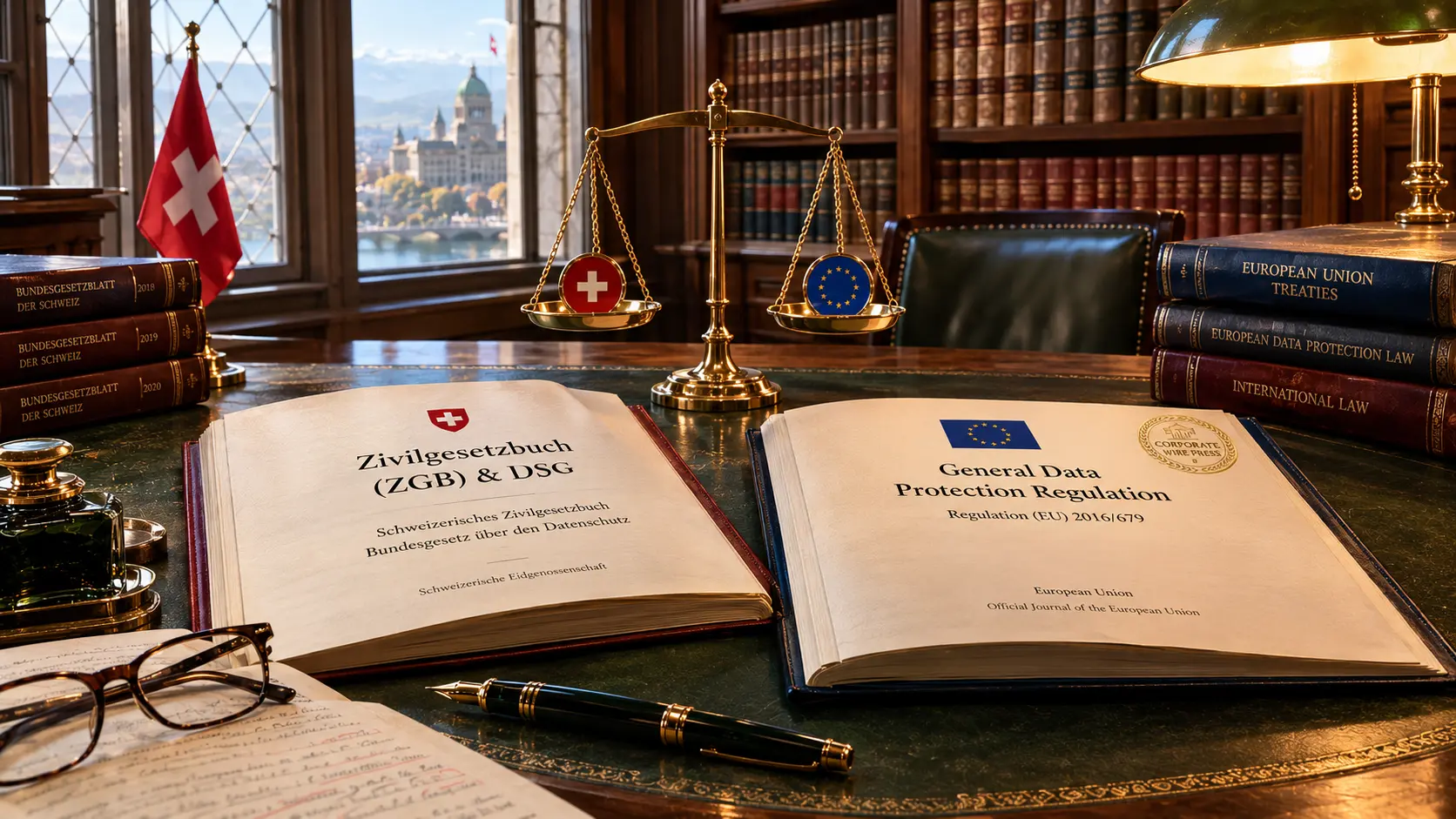
- Fundamental Jurisprudential Divergence: While EU GDPR operates on a prohibition model (Verbotsprinzip) where processing is unlawful unless justified by an Article 6 legal basis, Swiss nFADP operates on a permissive model where private processing is lawful unless it breaches civil personality rights without justification.
- Civil Law Personality Roots: Swiss data privacy is an offshoot of personality protection under Article 28 of the Swiss Civil Code (ZGB), focusing on personal dignity and autonomy rather than administrative state control.
- Consent Hierarchy: Under Swiss law, consent is not the primary requirement for lawful processing; it is only required if a statutory personality violation occurs, or when conducting "High-Risk Profiling" or processing sensitive personal data.
- Governance Flexibility: Appointing a Data Protection Advisor (Datenschutzberater) remains voluntary for private entities under Swiss law, in stark contrast to the mandatory Data Protection Officer (DPO) criteria established under GDPR Article 37.
- Individual Criminal Accountability: Swiss law imposes direct criminal fines up to CHF 250,000 against natural persons (executives, managers) who commit intentional statutory violations, establishing a profound personal liability contrast to GDPR corporate turnover fines.
The Philosophical Divide: Public Regulatory Prohibition vs. Civil Personality Rights
At first glance, Switzerland’s revised Federal Act on Data Protection (nFADP, SR 235.1) and the European Union’s General Data Protection Regulation (Regulation (EU) 2016/679, "GDPR") appear nearly indistinguishable. Both legal texts mandate transparent data handling, enforce Data Protection Impact Assessments (DPIAs), codify Privacy by Design and Privacy by Default, and guarantee individuals the rights of access, rectification, and erasure.
However, beneath these surface similarities lies a profound philosophical divergence in legal doctrine. To understand why Swiss data protection law operates with distinct practical flexibility—and where it imposes sudden, severe liability—one must examine the intellectual roots of both legal systems.
The European Union’s GDPR is an administrative regulatory regime rooted in fundamental public rights (Article 8 of the EU Charter of Fundamental Rights). It is built upon the foundational doctrine of general prohibition (Verbotsprinzip): all processing of personal data is deemed fundamentally unlawful from the outset unless the data controller can establish one of the six rigid, exhaustive legal grounds enumerated in GDPR Article 6(1).
In contrast, Switzerland’s nFADP is directly anchored in Swiss private and civil law—specifically, the doctrine of personality rights (Persönlichkeitsschutz) codified in Article 28 of the Swiss Civil Code (ZGB). Under Swiss private law, commercial enterprises and private individuals (private Personen) are fundamentally free to process personal data without seeking state or statutory authorization, provided that general legal principles are respected and the processing does not unlawfully infringe upon the human personality.
The Core Principles: How Swiss nFADP Principles Compare to GDPR Article 5
Both statutes establish overarching data processing principles that govern all data activities. In Switzerland, these principles are set forth in Article 6 nFADP; in the EU, they are codified in Article 5 GDPR.
1. Lawfulness (Rechtmässigkeit): Processing must comply with the law. While GDPR interprets this as possessing an Article 6 legal basis, Swiss law interprets it as not violating statutory law or committing an unlawful tort against personality rights;
2. Good Faith (Treu und Glauben / Fairness): Data processing must be conducted honestly and transparently, without deceit or hidden secondary intentions;
3. Proportionality (Verhältnismässigkeit): The processing must be commensurate and strictly necessary to achieve the stated purpose. Data minimization is a core component of this principle in both regimes;
4. Purpose Limitation (Zweckbindung): Personal data may be collected only for a specific purpose that is recognizable to the data subject, and it may only be processed compatibly with that purpose;
5. Data Accuracy (Richtigkeit): The controller must take all reasonable measures to ensure that personal data is correct and kept up to date, rectifying or erasing inaccurate records;
6. Data Security (Datensicherheit): Pursuant to Article 8 nFADP and GDPR Article 32, controllers and processors must implement adequate technical and organizational measures (TOMs) to protect personal data against unauthorized access, loss, or destruction;
7. Retention Limitation & Storage Minimization: Personal data must be destroyed or anonymized as soon as it is no longer required for the purpose of the processing.
Comparative Table: Core Statutory Mechanics & Legal Requirements
The following statutory matrix contrasts the essential operational requirements between the Swiss nFADP and the EU GDPR.
| Statutory Mechanism | Swiss nFADP (SR 235.1) | EU GDPR (Regulation 2016/679) | Operational Practice Distinction |
|---|---|---|---|
| Default Legality Rule | Permissive: Processing lawful unless personality rights breached (Art. 6 nFADP). | Prohibitive: Processing unlawful unless justified by Art. 6(1) legal basis. | Swiss private companies do not need to identify an Article 6 legal basis prior to routine processing. |
| Justification Grounds | Justification required only upon personality infringement (Art. 30 nFADP). | Legal basis mandatory for every single processing activity (Art. 6 GDPR). | Swiss justifications include consent, overriding private/public interest, or statutory authorization. |
| Scope of Protected Data | Natural persons exclusively (Art. 5(a) nFADP since Sept 1, 2023). | Natural persons exclusively (Art. 4(1) GDPR). | Harmonized: Pure B2B enterprise company records are excluded from both data privacy laws. |
| Sensitive Data Scope | Includes genetic data, social security measures, and criminal records (Art. 5(c)). | Special category data includes biometrics, genetics, health, and beliefs (Art. 9). | Swiss law specifically classifies social security measures and criminal proceedings as sensitive. |
| High-Risk Profiling | Explicit statutory category for profiling assessing essential personality (Art. 5(f)). | Profiling defined generally (Art. 4(4)); automated decisions restricted (Art. 22). | Deep behavioral analytics trigger explicit consent requirements under Swiss law if rights are impacted. |
| Data Protection Officer | Data Protection Advisor (Datenschutzberater) is voluntary for private firms (Art. 10). | Data Protection Officer (DPO) is mandatory for core large-scale monitoring (Art. 37). | Appointing a Swiss Advisor provides corporate relief: waives mandatory FODPC consultation on DPIAs. |
| Breach Notification Clock | Notification required "as quickly as possible" for high-risk breaches (Art. 24). | Strict 72-hour hard notification deadline to supervisory authority (Art. 33). | Swiss law applies a risk-calibrated rapid notification standard without a rigid hourly countdown. |
| Penalties & Fines | Criminal fines up to CHF 250,000 imposed on natural persons (Arts. 60–66). | Administrative fines up to €20,000,000 or 4% of global annual turnover (Art. 83). | Swiss law targets the individual C-suite officer; GDPR targets the enterprise corporate entity. |
Consent Standards: Explicit vs. Implied Consent and High-Risk Profiling
Under the EU GDPR, consent (Article 4(11) and Article 7) is defined as a freely given, specific, informed, and unambiguous indication of the data subject's wishes by a clear affirmative action. Implied or tacit consent is strictly invalid across the European Union.
Under Swiss nFADP Article 6(6), the consent standard is nuanced:
• Standard Consent May Be Implied: For routine data processing, consent may be given implicitly if the circumstances clearly demonstrate that the individual understood and agreed to the processing (e.g., continuing to use a service after being presented with a clear notice);
• Mandatory Express Consent (Ausdrückliche Einwilligung): Swiss law strictly mandates explicit, express consent only in specific statutory scenarios:
1. When processing sensitive personal data (besonders schützenswerte Personendaten pursuant to Art. 5(c)); 2. When conducting "High-Risk Profiling" (Profilierung mit hohem Risiko pursuant to Art. 5(f)); and 3. When a federal body (Bundesorgan) conducts standard profiling.
In the context of artificial intelligence, machine learning systems that correlate multi-vector data points to synthesize an essential composite of an individual’s personality (e.g., algorithmic credit underwriting or automated psychological profiling) legally cross into Swiss high-risk profiling, requiring active, affirmative opt-in consent.
The Governance Dichotomy: Data Protection Advisor vs. DPO and RoPA Mandates
Corporate organizational governance represents another critical area of statutory divergence between the Swiss Confederation and the European Union.
1. Data Protection Advisor vs. DPO: Under GDPR Article 37, appointing a Data Protection Officer is mandatory for public authorities, entities conducting regular and systematic monitoring of individuals on a large scale, or entities processing special category data at scale. Under Swiss nFADP Article 10, private entities are never legally required to appoint a Data Protection Advisor (Datenschutzberater). However, Swiss law creates a powerful corporate incentive: if an enterprise conducts a Data Protection Impact Assessment (DPIA) that demonstrates unmitigated high risks, it is normally required to consult the Swiss Federal Commissioner (FODPC). If the company has appointed an independent Data Protection Advisor and consulted them, the mandatory FODPC consultation is completely waived under Article 23(4) nFADP.
2. Record of Processing Activities (RoPA) SME Exemption: Under GDPR Article 30(5), companies with fewer than 250 employees are technically exempt from the RoPA requirement, but in practice, the exemption is virtually useless because it does not apply if the processing is non-occasional (which applies to almost all ongoing software operations). In Switzerland, Article 12 nFADP and Article 24 DPO establish a genuine, functional SME exemption for companies with fewer than 250 employees, unless the processing poses a high risk to data subjects or involves large-scale processing of sensitive data.
Enforcement and Liability: Cantonal Prosecutors vs. European Data Protection Authorities
The enforcement architecture of Swiss data protection law is unique in international privacy law. While European Union DPAs (such as the Irish DPC, French CNIL, or German BfDI) act as administrative enforcement agencies capable of issuing massive corporate fines directly against corporate balance sheets, the Swiss Federal Data Protection and Information Commissioner (FODPC / EDÖB) has no authority to issue administrative financial penalties.
Instead, the FODPC possesses investigative and administrative ordering powers (e.g., ordering the suspension of processing, the rectification of records, or the deletion of datasets).
Financial penalties under Swiss nFADP (Articles 60–66) are strictly criminal in nature. They are investigated and prosecuted by the competent Cantonal Public Prosecutors' Offices (kantonale Staatsanwaltschaften) and adjudicated by ordinary criminal courts. Most critically, these criminal fines of up to CHF 250,000 are not levied against the corporate entity; they are levied directly against the culpable natural persons (board members, executive directors, or data protection leads) who committed the intentional violation.
While criminal liability requires intentional action (Vorsatz)—meaning simple negligence is not punishable—deliberately bypassing Swiss statutory duties or willfully ignoring binding FODPC orders exposes corporate leadership to personal criminal convictions.
Frequently Asked Questions: Swiss FADP vs. EU GDPR Core Differences
The following inquiries address foundational questions regarding the comparative interpretation of Swiss and European data protection law.
1. Is Switzerland formally bound by the EU GDPR?
No. Switzerland is not a member of the European Union or the European Economic Area (EEA). Swiss sovereign law is governed by the Swiss Federal Act on Data Protection (nFADP). However, the EU GDPR applies extraterritorially to Swiss companies if they offer goods or services to individuals in the EU or monitor their behavior within the EU pursuant to GDPR Article 3(2).
2. Can a company use a single combined privacy policy for Switzerland and the European Union?
Yes, provided it is properly tailored. A dual-compliant privacy policy must specify both the EU GDPR and Swiss nFADP, name the Swiss Federal Data Protection and Information Commissioner (FODPC) as a competent supervisory authority, explicitly disclose all foreign recipient countries for data transfers, and differentiate between EU and Swiss individual rights.
4. Can an executive be fined for simple negligence under the Swiss nFADP?
No. Articles 60–66 nFADP strictly require intentional conduct (Vorsatz) for criminal penalties to apply. Simple negligence, accidental error, or administrative oversight is not criminally punishable under Swiss data protection law.
Conclusion: Mastering the Interoperability of Swiss and European Privacy Laws
While the European Union’s GDPR and Switzerland’s revised FADP stem from different legal traditions—one administrative and regulatory, the other civil and personality-focused—they share a profound functional harmony. Both legal systems reject unconstrained digital surveillance, enforce technical privacy safeguards, and hold organizations accountable for how they handle personal information.
By understanding the core statutory mechanics that separate the two regimes—from permissive legality and high-risk profiling consent to personal criminal liability—enterprise leaders can build unified data governance architectures that ensure seamless compliance, protect corporate officers, and foster unshakeable trust across global markets.
Julian Vance has spent 18 years counseling Fortune 500 AI platforms and multinational financial groups on compliance with Swiss FADP, EU GDPR, and cross-border data transfer mechanisms.
Further Recommended Readings from Our Desks
Swiss-US Data Privacy Framework vs. EU GDPR: Cross-Border Data Transfers for AI Systems
A technical and regulatory analysis of transatlantic data transfers for artificial intelligence platforms, comparing the Swiss-U.S. Data Privacy Framework with EU GDPR transfer mechanisms, Standard Contractual Clauses, and sovereign cloud infrastructure.
Implications of Swiss Privacy Law & GDPR for AI Companies: Strategy, Risks & Market Access
Strategic analysis for machine learning executives, venture-backed AI labs, and enterprise SaaS providers evaluating jurisdictional advantages, cross-border liabilities, and European market expansion.
AI Privacy Compliance Roadmap: How AI Providers Comply with Swiss FADP and EU GDPR
A step-by-step implementation blueprint for machine learning developers, SaaS vendors, and enterprise technology leaders navigating simultaneous Swiss nFADP and European Union GDPR mandates.