
Swiss nFADP 2023 vs. EU GDPR: Key Provisions, Statutory Analysis & AI System Rules
An exhaustive article-by-article statutory analysis mapping Switzerland’s revised Federal Act on Data Protection against the EU GDPR for AI system developers, data controllers, and algorithmic auditors.

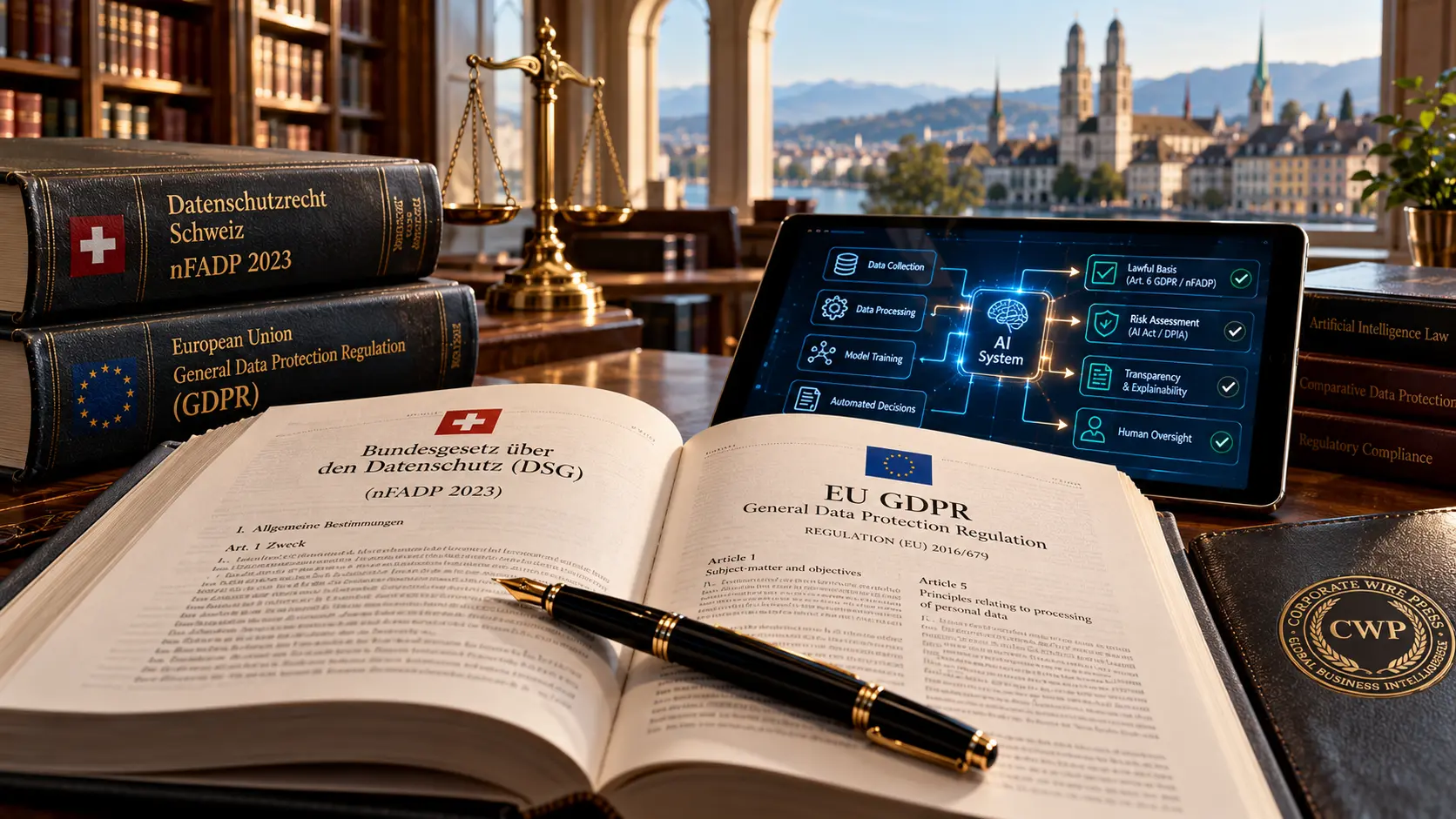
- Statutory Evolution: The total revision of the Swiss Federal Act on Data Protection (nFADP), approved by Parliament in September 2020 and enacted on September 1, 2023, modernized Swiss privacy law to mirror European digital market standards without copying GDPR verbatim.
- Article-by-Article Alignment: Core concepts—including Privacy by Design (Art. 7 nFADP / Art. 25 GDPR), Processor Contracts (Art. 8 nFADP / Art. 28 GDPR), and Data Protection Impact Assessments (Art. 22 nFADP / Art. 35 GDPR)—share structural parity, but Swiss rules grant greater operational flexibility for private entities.
- Expanded Sensitive Data for AI: Swiss nFADP Article 5(c) includes genetic data and administrative/criminal proceedings within its sensitive personal data definition, alongside a distinct statutory category for biometric data identifying a natural person.
- Mandatory Privacy by Design & Default: Developers of machine learning models must architect technical safeguards from the earliest conceptual engineering phase, ensuring default parameters disable unauthorized training data retention and automated profiling.
- Algorithmic Explainability & Human Escalation: Swiss nFADP Article 21 guarantees individuals the right to be informed of purely automated individual decisions, granting data subjects the right to challenge outputs and demand human review by a natural person.
Legislative History: The 2020 Revision and the September 1, 2023 Entry into Force
The modernization of Swiss data protection law represents one of the most deliberate statutory overhauls in modern European jurisprudence. The original Swiss Federal Act on Data Protection of June 19, 1992 (old FADP), while pioneering in the early computing era, was fundamentally ill-equipped to govern contemporary cloud architectures, algorithmic profiling, biometric identification, and distributed artificial intelligence models.
Following the European Union’s implementation of the General Data Protection Regulation (GDPR) in May 2018 and the modernization of Council of Europe Convention 108 (Convention 108+), the Swiss Federal Assembly embarked on a comprehensive total revision (Totalrevision des Datenschutzgesetzes). On September 25, 2020, Parliament formally enacted the revised Federal Act on Data Protection (new FADP or "nFADP", SR 235.1), which officially entered into force alongside the Data Protection Ordinance (DPO, SR 235.11) on September 1, 2023, without any transitional transition periods for commercial private controllers.
The primary legislative objective was twofold: first, to elevate the protection of Swiss citizens’ personality and fundamental rights against intrusive algorithmic processing; second, to ensure Switzerland retained its crucial "adequacy status" under GDPR Article 45, preserving frictionless cross-border commercial data flows with the European Union while maintaining Switzerland’s distinct, business-friendly legal autonomy.
Article-by-Article Comparison: Swiss nFADP vs. Corresponding GDPR Articles
For corporate legal counsel and machine learning compliance officers building dual-compliant governance architectures, mapping specific statutory clauses between the Swiss nFADP and the EU GDPR is an indispensable operational exercise. The following exhaustive statutory concordance illustrates the structural harmonization and critical technical distinctions between both texts.
| Subject / Regulatory Mandate | Swiss nFADP (SR 235.1) | EU GDPR (Regulation 2016/679) | Key Statutory Difference & AI Impact |
|---|---|---|---|
| Definitions: Personal Data | Art. 5(a) nFADP | Art. 4(1) GDPR | Harmonized: Both restrict "personal data" strictly to natural persons. Legal entities are excluded under nFADP since Sept 1, 2023. |
| Definitions: Sensitive Personal Data | Art. 5(c) nFADP | Art. 9(1) GDPR | Swiss law explicitly includes genetic data and administrative/criminal social security proceedings as sensitive categories. |
| Definitions: Profiling & High-Risk Profiling | Art. 5(f) nFADP | Art. 4(4) & Art. 22 GDPR | Swiss law creates an explicit statutory tier for "High-Risk Profiling" that pairs data to synthesize an essential portrait of personality. |
| General Processing Principles | Art. 6 nFADP | Art. 5 GDPR | Both require lawfulness, good faith, purpose limitation, proportionality, and transparency. Swiss law is grounded in civil personality protection. |
| Privacy by Design & Default | Art. 7 nFADP | Art. 25 GDPR | Substantively aligned: Requires technical and organizational measures from the earliest design stage of machine learning pipelines. |
| Data Processors (Subcontracting) | Art. 8 nFADP | Art. 28 GDPR | Swiss law requires prior consent of controller to engage sub-processors; contractual terms mirror GDPR Data Processing Agreements (DPAs). |
| Data Protection Advisor (DPO) | Art. 10 nFADP | Arts. 37–39 GDPR | Voluntary for private entities in Switzerland; mandatory under GDPR for core large-scale monitoring. Appointing an Advisor grants Swiss DPIA relief. |
| Records of Processing (RoPA) | Art. 12 nFADP | Art. 30 GDPR | Swiss law exempts SMEs (<250 employees) unless processing sensitive data at scale or conducting high-risk algorithmic profiling. |
| Cross-Border Data Transfers | Arts. 16–17 nFADP | Arts. 44–49 GDPR | Federal Council publishes binding adequacy list. European Commission SCCs are recognized but require the mandatory Swiss Addendum. |
| Duty to Inform (Transparency) | Arts. 19–20 nFADP | Arts. 13–14 GDPR | Swiss controllers must inform of recipient countries abroad; GDPR mandates granular lists of legal bases for each processing activity. |
| Automated Individual Decisions | Art. 21 nFADP | Art. 22 GDPR | Swiss law grants the right to be informed, express views, and demand human review by a natural person for automated outputs. |
| Data Protection Impact Assessment (DPIA) | Arts. 22–23 nFADP | Arts. 35–36 GDPR | Mandatory for high-risk AI. In Switzerland, consultation with FODPC is waived if the controller consults an independent Data Protection Advisor. |
| Data Breach Notification | Art. 24 nFADP | Arts. 33–34 GDPR | Swiss law requires notification "as quickly as possible" (so rasch als möglich) upon high risk; GDPR strictly enforces a 72-hour hard deadline. |
| Sanctions & Penalties | Arts. 60–66 nFADP | Arts. 83–84 GDPR | Swiss law enforces criminal fines up to CHF 250,000 on culpable individuals for intentional acts; GDPR imposes corporate fines up to €20M / 4% turnover. |
Statutory Definitions: Sensitive Personal Data & Profiling with High Risk in AI Contexts
When designing machine learning pipelines that train on multimodal datasets, parsing the exact statutory boundaries of "sensitive personal data" and "profiling" determines whether an AI model triggers heightened compliance obligations.
Under Swiss nFADP Article 5(c), sensitive personal data (besonders schützenswerte Personendaten) encompasses:
1. Data on religious, philosophical, political, or trade union-related views or activities; 2. Data on health, the intimate sphere, or racial or ethnic origin; 3. Genetic data; 4. Biometric data that uniquely identifies a natural person (biometrische Daten, die eine natürliche Person eindeutig identifizieren); 5. Data on administrative or criminal proceedings and sanctions; and 6. Data on social security measures.
Notice that while GDPR Article 9 covers "special categories of personal data," Swiss law goes further by explicitly classifying social security measures and administrative/criminal proceedings as sensitive personal data. If an algorithmic model evaluates insurance claims, credit scores, or tenant applications in Switzerland, ingesting data concerning social security claims instantly triggers sensitive data restrictions.
Furthermore, Swiss nFADP Article 5(f) introduces the statutory concept of "High-Risk Profiling" (Profilierung mit hohem Risiko). This occurs whenever an algorithm correlates data points to construct a comprehensive profile of an individual’s personality. In practice, deep behavioral scoring algorithms—such as AI engines predicting employee turnover, customer churn, or medical propensities—fall squarely within this high-risk classification.
Privacy by Design and Privacy by Default Obligations for Algorithm Developers
Article 7 nFADP codifies the dual principles of Privacy by Design (Datenschutz durch Technikgestaltung) and Privacy by Default (Datenschutz durch datenschutzfreundliche Voreinstellungen), directly mirroring GDPR Article 25.
For AI system architects and machine learning engineers, these statutory principles are not merely aspirational best practices; they are legally binding developmental mandates. Under Article 7(1) nFADP, controllers must design data processing systems from the planning and conceptual stage to guarantee that data protection principles—particularly proportionality and purpose limitation—are technically enforced.
Under Article 7(2) nFADP, the controller must ensure through appropriate technical defaults that data processing is restricted to the minimum required for the stated purpose, unless the data subject explicitly chooses otherwise.
When deploying AI and LLM services, Privacy by Design and Default requires:
• Zero Data Retention for Model Training: Default API configurations must ensure user inputs, prompts, and inference queries are not cached or ingested to re-train public foundation models without express consent; • Automated Anonymization & Pseudonymization: Embedding pipelines and vector databases must sanitize direct identifiers before ingesting enterprise data into retrieval-augmented generation (RAG) indices; • Granular Telemetry Opt-Ins: Application interfaces must ship with user tracking, prompt telemetry, and behavioral analytics disabled by default; • Automated Ephemeral Expiration: Prompt session caches must enforce strict time-to-live (TTL) parameters, purging temporary memory buffers upon completion of the user session.
Transparency & Information Duties: Algorithmic Explainability Requirements
Under both Swiss nFADP (Articles 19–21) and EU GDPR (Articles 13–15 and 22), the era of deploying unscrutinized "black-box" artificial intelligence systems against European consumers has officially closed.
Article 19 nFADP establishes an active information duty: whenever personal data is collected, the controller must inform the data subject regarding:
1. The identity and contact details of the controller; 2. The specific purpose of the processing; 3. The recipients or categories of recipients if data is disclosed; 4. The foreign countries to which data is transferred, including guarantees or adequacy mechanisms utilized; and 5. The existence of automated individual decisions.
Most critically for artificial intelligence services, Article 21 nFADP explicitly mandates that controllers must inform data subjects whenever a decision is taken exclusively on the basis of automated data processing that produces legal effects concerning them or significantly affects them (automatisierte Einzelentscheidungen).
This requires machine learning providers to achieve technical explainability (Erklärbarkeit). It is no longer sufficient to state that an algorithm approved or denied an application; the controller must be capable of elucidating the key features, weights, and decision logic that determined the automated outcome.
Rights of Data Subjects Regarding AI Decisions: Access, Rectification & Human Intervention
Both Swiss nFADP and EU GDPR arm data subjects with robust procedural rights to contest and audit algorithmic classifications.
Under Swiss nFADP Article 25, any individual may request confirmation from a controller as to whether personal data concerning them is being processed. In an AI context, this right of access encompasses:
• All personal data undergoing algorithmic processing; • The purpose of the AI processing and duration of storage; • Available information regarding the origin of training and prompt data; • Disclosure of any automated individual decisions and the underlying logic involved.
Furthermore, pursuant to Article 21(2) nFADP, when an automated individual decision is rendered, the data subject possesses the fundamental statutory right to:
1. Express their personal point of view regarding the algorithmic classification; 2. Demand that the decision be formally reviewed by a qualified human being (Überprüfung durch eine natürliche Person); and 3. Challenge inaccurate algorithmic inferences or demand rectification under Article 32 nFADP.
This establishes a mandatory architectural requirement for AI developers: every automated scoring or decision-making platform must maintain a "human-in-the-loop" escalation workflow capable of pausing, reviewing, and overturning automated model outputs.
Enterprise AI Governance Checklist: Achieving Simultaneous Swiss nFADP & EU GDPR Compliance
To ensure comprehensive regulatory defensibility across Swiss and European jurisdictions, enterprise AI providers should execute the following eight-point compliance protocol:
| Governance Domain | Required Operational Action | Swiss nFADP Rule | EU GDPR Rule |
|---|---|---|---|
| Data Ingestion Audits | Audit training corpora to exclude sensitive personal data, genetic data, and criminal proceedings unless explicit consent is secured. | Art. 5(c) nFADP | Art. 9 GDPR |
| Privacy by Design | Configure LLM inference APIs with zero-data retention by default; prevent prompt caching for foundational retraining. | Art. 7 nFADP | Art. 25 GDPR |
| High-Risk Profiling Review | Evaluate whether behavioral scoring models aggregate disparate vectors to create an essential personality portrait. | Art. 5(f) nFADP | Art. 4(4) & 22 GDPR |
| AI DPIA Execution | Draft technical Data Protection Impact Assessments detailing model architectures, failure modes, and differential privacy mitigations. | Art. 22 nFADP | Art. 35 GDPR |
| Data Protection Advisor | Appoint an independent Swiss Data Protection Advisor to eliminate mandatory FODPC consultation upon residual DPIA risks. | Art. 10 nFADP | Arts. 37–39 GDPR |
| Cross-Border Addenda | Execute EU Standard Contractual Clauses augmented with the mandatory Swiss Jurisdictional Addendum for non-EEA GPU transfers. | Art. 16 nFADP | Arts. 44–46 GDPR |
| Explainability Interfaces | Build user-facing explainability dashboards detailing primary input factors driving automated decision scores. | Art. 21 nFADP | Arts. 13–15 & 22 GDPR |
| Human Review Escalation | Deploy operational workflows allowing users to challenge automated decisions and trigger human oversight by a qualified person. | Art. 21(2) nFADP | Art. 22(3) GDPR |
Frequently Asked Questions: Swiss nFADP 2023 Statutory AI Rules
The following inquiries address technical statutory questions regarding the implementation of the revised Swiss Data Protection Act.
1. What is the deadline for notifying data breaches under Swiss nFADP compared to GDPR?
Unlike GDPR Article 33, which imposes a strict 72-hour notification deadline to supervisory authorities, Swiss nFADP Article 24 requires the controller to notify the Federal Commissioner (FODPC) "as quickly as possible" (so rasch als möglich) only if the data security breach is likely to result in a high risk to the personality or fundamental rights of data subjects. Switzerland avoided rigid hourly deadlines, opting for a risk-calibrated rapid notification standard.
2. Are Swiss AI startups exempt from maintaining a Record of Processing Activities (RoPA)?
Under Article 12 nFADP and Article 24 DPO, companies with fewer than 250 employees are generally exempt from the RoPA mandate. However, this exemption explicitly does not apply if the processing involves high risks to data subjects’ personality—which includes high-risk algorithmic profiling or large-scale automated processing of sensitive personal data. Consequently, most AI startups developing predictive profiling engines must maintain a compliant RoPA.
3. How does Swiss nFADP categorize biometric data processed by AI computer vision models?
Under Article 5(c)(4) nFADP, biometric data is classified as sensitive personal data only when it uniquely identifies a natural person (biometrische Daten, die eine Person eindeutig identifizieren). Purely technical image processing (such as computer vision detecting facial shapes for lighting adjustments) is not sensitive unless used for one-to-one verification or one-to-many facial identification.
4. Who enforces and prosecutes criminal offenses under the Swiss nFADP?
The Federal Data Protection and Information Commissioner (FODPC) does not impose criminal penalties. Criminal offenses under Articles 60–66 nFADP are prosecuted by the competent cantonal public prosecutors' offices (kantonale Staatsanwaltschaften). The FODPC may investigate and issue binding administrative orders, and can report suspected intentional violations to cantonal prosecuting authorities.
Conclusion: The Future of Cross-Border AI Governance in Switzerland
The total revision of the Swiss Federal Act on Data Protection establishes Switzerland as a preeminent global jurisdiction for trustworthy, enterprise-grade artificial intelligence innovation. By harmonizing key statutory constructs with the EU GDPR while preserving a principle-based civil law framework, the nFADP offers technology providers exceptional commercial clarity.
However, regulatory agility requires ongoing diligence. As the European Union moves to implement the EU AI Act (Regulation (EU) 2024/1689), Swiss authorities and legal scholars are actively evaluating the necessity of complementary Swiss algorithmic governance frameworks. Technology leaders who embed Privacy by Design, maintain comprehensive DPIAs, and architect transparent human-in-the-loop workflows today will remain insulated against future regulatory disruption across Switzerland, Europe, and the global digital economy.
Julian Vance has spent 18 years counseling Fortune 500 AI platforms and multinational financial groups on compliance with Swiss FADP, EU GDPR, and cross-border data transfer mechanisms.
Further Recommended Readings from Our Desks
Swiss FADP vs. EU GDPR: Core Legal Differences, Principles & Requirements Explained
A foundational legal analysis examining the core philosophical doctrines, statutory principles, consent standards, and governance requirements that distinguish Swiss data protection law from the EU GDPR.
Swiss-US Data Privacy Framework vs. EU GDPR: Cross-Border Data Transfers for AI Systems
A technical and regulatory analysis of transatlantic data transfers for artificial intelligence platforms, comparing the Swiss-U.S. Data Privacy Framework with EU GDPR transfer mechanisms, Standard Contractual Clauses, and sovereign cloud infrastructure.
Implications of Swiss Privacy Law & GDPR for AI Companies: Strategy, Risks & Market Access
Strategic analysis for machine learning executives, venture-backed AI labs, and enterprise SaaS providers evaluating jurisdictional advantages, cross-border liabilities, and European market expansion.