
The Art of Writing "Thank You for Your Business" Notes (Templates & Gift Messages)
Find professional and friendly ways to say “thank you for your business,” with message examples you can use to appreciate customers and clients.

- Customer appreciation is an active retention strategy; studies indicate a 5% bump in client retention expands enterprise profit margins by 25% to 95%.
- The highest-impact "thank you for your business" notes avoid generic platitudes by anchoring gratitude to a specific project milestone, tangible outcome, or shared achievement.
- A structured note balances four distinct epistolary components: personalized salutation, concrete operational anchor, statement of relational impact, and forward-looking horizon.
- Handwritten notes yield an unmatched tactile impression for high-ARR accounts and renewals, whereas structured emails excel for rapid invoice milestones and agile project completions.
- Gift enclosure messages must remain concise, compliant with corporate gift limits, and centered entirely on client success rather than self-serving cross-selling.
Why Genuine Customer Appreciation Boosts Client Retention and Referrals
In an era dominated by automated drip sequences, AI-generated marketing touches, and algorithmic ticketing systems, genuine human acknowledgment has become an increasingly scarce corporate asset. Most organizations treat customer appreciation as an afterthought—an obligatory checkbox relegated to generic invoice footers or automated receipt receipts. However, enterprise relationship data repeatedly proves that intentional, personalized gratitude operates as a core financial catalyst rather than mere social politeness.
Pioneering research by Bain & Company reveals that increasing customer retention rates by just 5% increases profits by 25% to 95%. When clients perceive that an agency, vendor, or advisory partner genuinely values their relationship beyond the transactional exchange of capital, their psychological switching barriers rise substantially. A sincere "thank you for your business" note dissolves the sterile vendor-client dichotomy, re-anchoring the dynamic into an enduring strategic partnership.
Furthermore, intentional gratitude drives organic referral velocity. Delighted clients who receive thoughtful, bespoke acknowledgment are statistically more predisposed to advocate for your firm across industry peer networks, procurement roundtables, and board-level vendor reviews. Gratitude activates the social principle of reciprocity: by recognizing the client's trust and investment, you cultivate an emotional surplus that withstands minor operational hiccups, market volatility, and competitive RFP solicitations.
How to Structure a Personalized "Thank You for Your Business" Note
The fundamental failure of standard corporate thank-you notes is generic homogenization. When a client receives a pre-printed card reading "We value your business," the message communicates administrative routine rather than authentic appreciation. To cut through corporate cynicism, an effective note must be architected around explicit, contextual particulars that could only apply to that specific client engagement.
A compelling customer appreciation note follows an authoritative four-part epistolary structure: the Contextual Salutation, the Concrete Operational Anchor, the Value/Impact Articulation, and the Forward Collaborative Horizon. By progressing methodically through these four movements, your message achieves professional warmth without slipping into sycophancy or transactional awkwardness.
The 4-Part Executive Architecture
1. The Contextual Salutation: Address the recipient with respectful familiarity tailored to your established working rapport. In senior enterprise spheres, prefer "Dear [First Name]" or "Dear [Title Last Name]" over informal greetings like "Hey there." This establishes an intentional, focused tone from the initial syllable.
2. The Concrete Operational Anchor: Immediately reference the exact project, mandate, product deployment, or milestone that motivated the communication. Name the initiative explicitly (e.g., "our rollout of the European logistics architecture" or "your Q3 brand overhaul"). This proves unequivocally that the note was penned by an engaged collaborator rather than an automated script.
3. The Value and Impact Articulation: Emphasize the collaborative spirit and human excellence of the client's internal team. Acknowledge their diligence, strategic clarity, or trust during challenging deadlines. Highlight what working together accomplished, framing the victory as a joint triumph.
4. The Forward Collaborative Horizon: Conclude with an uplifting, non-transactional statement looking toward future shared milestones. Crucially, resist the temptation to pitch additional services, request reviews, or attach sales literature. An authentic thank-you note must remain a pure gift of gratitude; inserting a commercial call-to-action instantly degrades its psychological value.
Templates for Invoices, Holiday Cards, Project Completions, and Contract Renewals
Adapting your appreciation to the specific touchpoint ensures maximum resonance. Below are four battle-tested executive templates, calibrated for diverse professional contexts ranging from formal financial documentation to celebratory milestone deliveries.
Template 1: Formal Invoice & Billing Enclosure Note
Invoices are inherently transactional, which makes pairing them with a thoughtful note exceptionally disarming. When sending an invoice or acknowledging final settlement, a concise note reinforces mutual respect and highlights the value delivered during the billing cycle.
Script Example: "Dear [Client Name], Enclosed is our invoice for the completion of [Project/Deliverable Name]. Beyond the ledger, our entire team wants to express our sincere appreciation for your continued business and trust. Partnering with your team throughout this phase has been immensely rewarding, particularly your collaborative guidance during [Specific Phase or Challenge]. We look forward to supporting your upcoming milestones in the months ahead. Warm regards, [Your Name & Title]"
Template 2: Major Project Completion & Milestone Delivery
The conclusion of a major initiative is the optimal psychological moment to cement long-term loyalty. The client team is experiencing relief and satisfaction from the deliverable, making them uniquely receptive to heartfelt recognition.
Script Example: "Dear [Client Name], As we finalize the deployment of [Initiative Name], I wanted to step back from our weekly status sprints and express our gratitude for your partnership. Delivering this platform ahead of schedule was only possible because of the decisive leadership and transparency demonstrated by you and your stakeholders. Thank you for entrusting our firm with such a critical organizational priority. We are thrilled to see the impact of this work take root across your organization. Sincerely, [Your Name & Title]"
Template 3: Annual Contract Renewal & Partnership Expansion
When an enterprise client re-signs an annual master services agreement (MSA) or commits to a multi-year retainer, they make an affirmative career bet on your capabilities. Acknowledging that commitment with executive gravity demonstrates that their loyalty is never taken for granted.
Script Example: "Dear [Client Name], Thank you for renewing your partnership with [Firm Name] for the upcoming year. In a competitive and rapidly shifting marketplace, your ongoing trust and patronage represent our highest professional honor. Over the past twelve months, we have taken enormous pride in [Name Key Collective Accomplishment]. As we embark on this next chapter, our commitment to your strategic objectives remains uncompromising. Thank you for your continued business and collaborative fellowship. With gratitude, [Your Name & Title]"
Template 4: Executive Holiday Card & Corporate Gift Enclosure
Year-end corporate gifts and holiday correspondence often get lost in a deluge of corporate gift baskets. An articulate, hand-signed card enclosure ensures your gift leaves a lasting impression that stands out against mass-produced promotional merchandise.
Script Example: "Dear [Client Name], As the year draws to a close, all of us at [Firm Name] want to convey our deepest gratitude for your business and partnership. Collaborating with your group on [Key Project/Account Area] has been a defining highlight of our year. Please accept this small token of our appreciation for you and your team. We wish you, your colleagues, and your family a restful holiday season and extraordinary success in the coming year. Warmest wishes, [Your Name & Leadership Team]"
Handwritten vs. Email Thank-You Messages: When Each Creates the Highest Impact
One of the most consequential strategic choices in customer correspondence is selecting the delivery medium: physical pen-and-paper versus high-velocity digital transmission. Neither medium is universally superior; each commands distinct communicative advantages depending on account value, urgency, geographical proximity, and operational cadence.
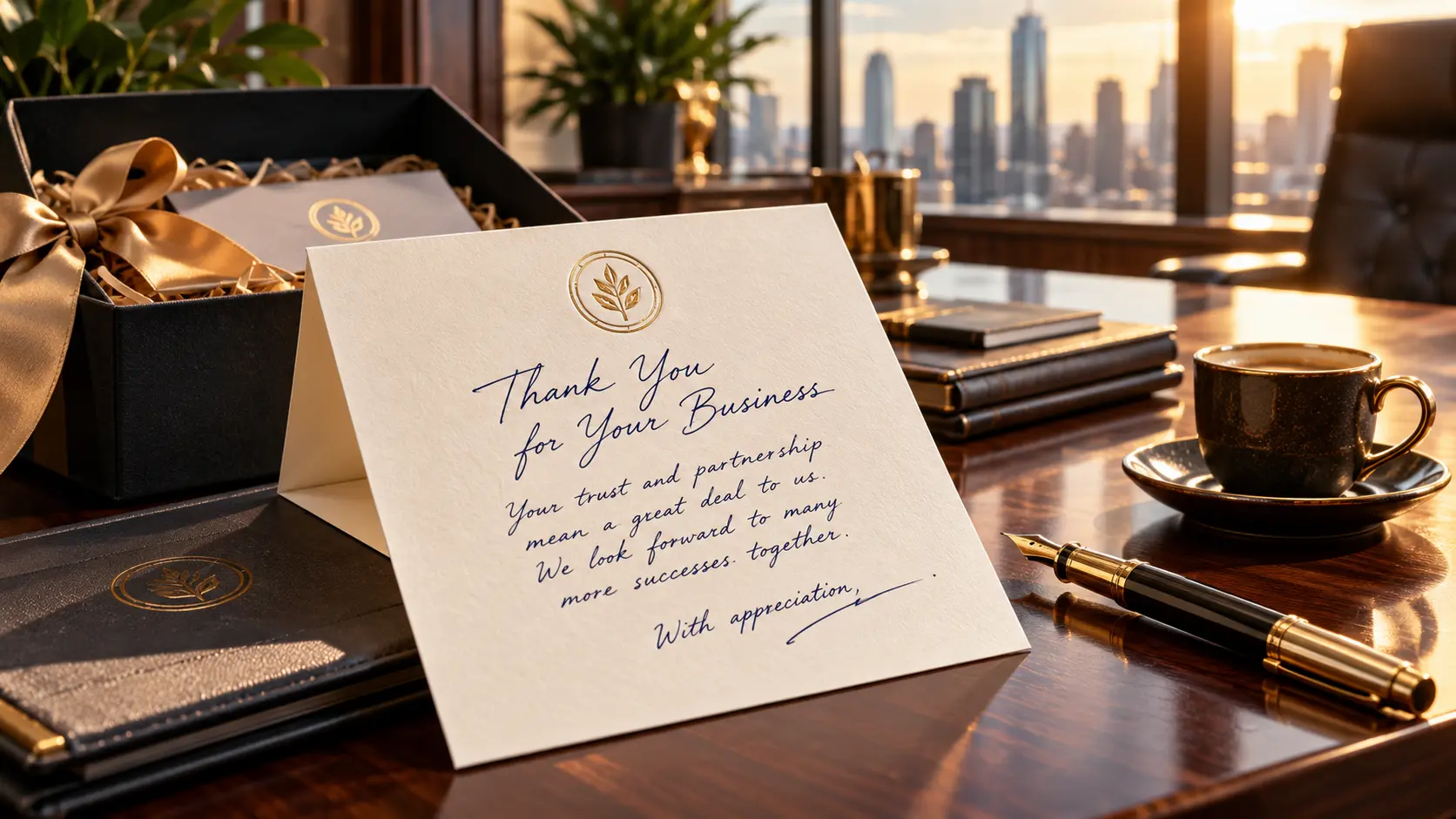
Handwritten notes command extraordinary emotional gravity. In a business world inundated with digital spam, receiving heavy cotton-stock stationery featuring personalized ink signals that a senior leader invested dedicated physical time and attention. However, handwritten cards require logistical lead time and cannot contain actionable hyperlinks or digital receipts. Conversely, structured email messages provide immediate delivery, transparent auditing, and seamless distribution across distributed client committees.
| Criterion | Handwritten Card on Heavy Stock | High-Touch Executive Email |
|---|---|---|
| Primary Emotional Impact | Exceptional; tactile, archival, and deeply personal | Polished, timely, efficient, and professional |
| Optimal Account Tier | Tier-1 Strategic Accounts, Enterprise Retainers, Key C-Suite Sponsors | Mid-market accounts, high-velocity accounts, weekly sprint milestones |
| Turnaround Velocity | 2 to 5 business days (mailing & logistics delay) | Immediate (sent within 2 hours of milestone completion) |
| Corporate Gift Compatibility | Ideal; tucked into executive packaging or bespoke book | Requires digital delivery (e.g., electronic voucher or digital code) |
| Compliance & Auditability | Personal; informal; rarely archived in corporate CRM | Public; easily archived in Salesforce, HubSpot, or billing audit trails |
| Recommended Frequency | Once or twice annually (Project Completion, Year-End, Renewal) | At every significant invoice settlement or quarterly review |
Frequently Asked Questions: Executive Client Appreciation
Q: When is the ideal time to send a client thank-you note? A: The golden window for sending appreciation is within 24 to 48 hours of a milestone event—such as contract execution, invoice settlement, or final deliverable sign-off. Sending notes too late diminishes emotional resonance, while sending them too early (before deliverables are validated) can appear premature.
Q: Should I include a promotional offer or referral request in a thank-you note? A: Absolutely not. Conflating gratitude with solicitation instantly discredits the authenticity of the message. If your goal is to gather referrals or propose an upsell, schedule that communication as a separate, distinct touchpoint at least two to three weeks later.
Q: What is the recommended etiquette for corporate gifts alongside notes? A: Keep corporate gifts modest, elegant, and relevant to the client's taste (such as specialized industry literature, high-end artisanal goods, or bespoke office desk items). Always review the client's corporate gift policy beforehand; many enterprise organizations and public-sector entities cap acceptable gift values at $25 to $50 or prohibit them entirely to avoid conflicts of interest.
Sarah Jenkins is a seasoned corporate speechwriter and organizational communications strategist with 15 years of experience counseling enterprise executives, board directors, and senior leaders on high-stakes rhetoric.
Further Recommended Readings from Our Desks
Swiss FADP vs. EU GDPR: Core Legal Differences, Principles & Requirements Explained
A foundational legal analysis examining the core philosophical doctrines, statutory principles, consent standards, and governance requirements that distinguish Swiss data protection law from the EU GDPR.
Swiss-US Data Privacy Framework vs. EU GDPR: Cross-Border Data Transfers for AI Systems
A technical and regulatory analysis of transatlantic data transfers for artificial intelligence platforms, comparing the Swiss-U.S. Data Privacy Framework with EU GDPR transfer mechanisms, Standard Contractual Clauses, and sovereign cloud infrastructure.
Implications of Swiss Privacy Law & GDPR for AI Companies: Strategy, Risks & Market Access
Strategic analysis for machine learning executives, venture-backed AI labs, and enterprise SaaS providers evaluating jurisdictional advantages, cross-border liabilities, and European market expansion.