
Does “Post” Mean Before or After? Meaning Explained
Does "post" mean before or after in time? Master the Latin temporal prefix "post-," compare "pre-" vs. "post-," decode post-mortem and post-op timelines, and apply hyphenation rules correctly.

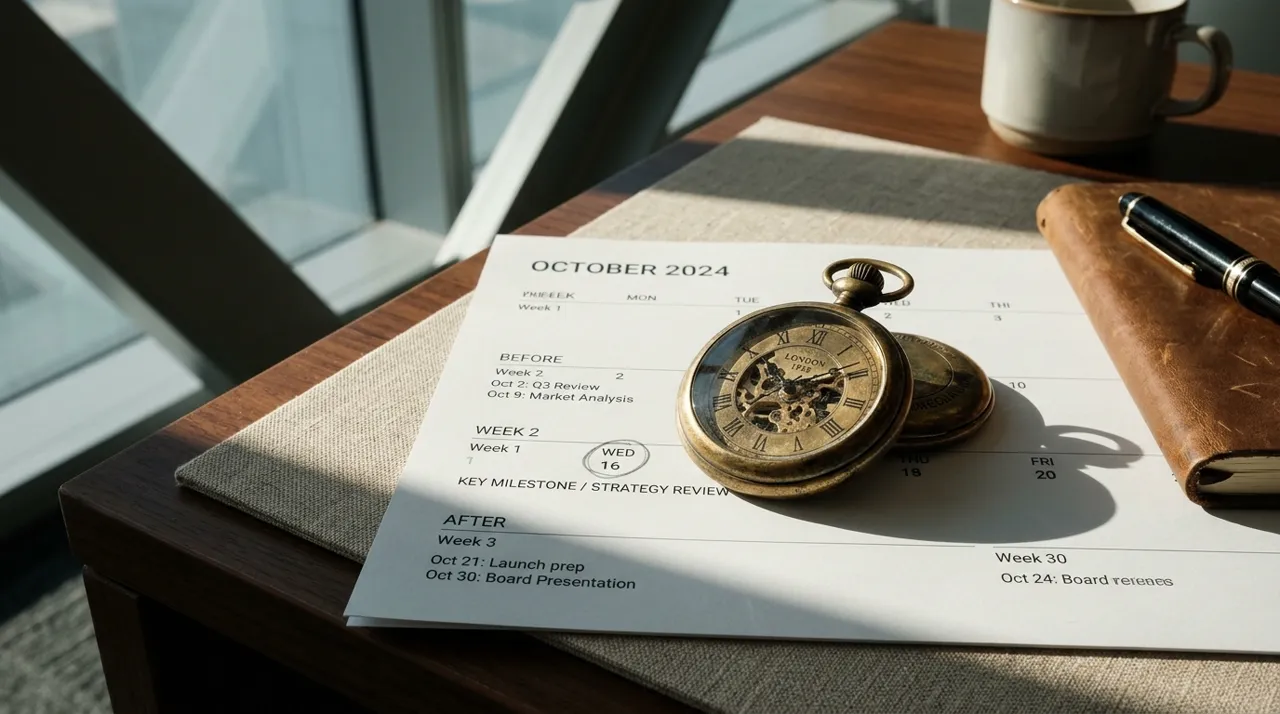
- Post- unambiguously means AFTER (or subsequent to, behind) in both time and physical position, derived directly from the Latin preposition post.
- Its direct chronological opposite is Pre- (meaning before or prior to), alongside related antecedents like ante- (before, as in antebellum or A.M.).
- Common temporal pairs clarify the sequence instantly: pre-launch happens before release, while post-launch happens after release; pre-op precedes surgery, while post-op follows it.
- Be careful not to confuse the Latin prefix post- (after) with the standalone English noun/verb post (a wooden pillar, job position, mailing service, or social media update), which comes from a completely different Latin root (ponere / positum, "to place").
- Under Chicago and AP Style conventions, most standard post- compounds are closed without a hyphen (postwar, postgraduate, postscript), while proper nouns and awkward vowel collisions keep the hyphen (post-COVID, post-WWII, post-industrial).
1. The Short Answer: Does "Post" Mean Before or After?
The prefix post- strictly and unambiguously means AFTER (subsequent in time, following an event, or behind in physical space). It never means before.
Whenever you encounter post- attached to the beginning of an English word, timeline milestone, or medical term, you can mentally substitute the words "after" or "following" and the meaning will lock into place immediately:
• Post-meeting briefing: A debriefing held after the meeting concludes.
• Postwar economy: Economic conditions occurring after a war ends.
• Post-op recovery: Medical care administered after an operation.
• Postscript (P.S.): A note written after the signature at the end of a letter.
Why do learners sometimes hesitate between "before" and "after"? Two culprits cause the confusion: the visual similarity to pre- (before) and past (earlier), and the completely separate standalone verb to post (such as posting an agenda before a meeting or posting a bail bond). Disentangling these roots removes all ambiguity.
2. Latin Etymology: Post- vs. Pre- vs. Ante- in Chronological Sequences
English inherited its precision timing prefixes directly from Classical Latin prepositions. In Latin, post meant "behind" in spatial terms and "after" or "later than" in temporal sequence. Conversely, prae (which entered English as pre-) and ante meant "in front of" or "before." Just as understanding Latin agent nouns clarifies vender vs. vendor spelling in procurement contracts, knowing these two pairs decodes hundreds of technical and business terms on sight.
The Complete Chronological Prefix Spectrum
| Latin Prefix | Literal Meaning | Direct Opposite | Everyday & Business Examples |
| :--- | :--- | :--- | :--- |
| Pre- | Before / Prior to | Post- | Pre-launch, pre-approval, pre-tax, prerequisite, preview |
| Ante- | Before / Preceding | Post- | Antemeridian (A.M.), antebellum, antechamber, antecedent |
| Intra- / Mid- | During / Inside | External to | Intraday trading, mid-quarter review, mid-project pivot |
| Post- | After / Subsequent to | Pre- / Ante- | Post-launch, post-mortem, post-tax, postgraduate, postscript |
The Classic Daily Proof: A.M. vs. P.M.
Every single clock on Earth demonstrates post in action twice a day:
• *A.M. (Ante Meridiem): Literally "before midday"* (morning hours before 12:00 noon).
• *P.M. (Post Meridiem): Literally "after midday"* (afternoon and evening hours after 12:00 noon).
If you remember that P.M. stands for *Post Meridiem (after noon), you can never forget that post always means after*.
3. Real-World Examples Across Business, Medicine, Law, and Academia
In modern enterprise journalism and specialized professions, the prefix post- anchors exact project lifecycles. Notice how consistently it divides timelines into clean before/after phases:
Corporate & Financial Management
• Post-merger integration (PMI): The complex phase occurring after two companies legally merge, harmonizing payroll, IT systems, and branding.
• Post-money valuation: A startup’s equity valuation calculated immediately after external venture capital funding is deposited into its balance sheet (contrasted with pre-money valuation before investment).
• Post-mortem (or Retroactive Analysis): A blameless diagnostic review conducted after a project outage, failed product launch, or quarterly campaign concludes.
• Post-dated check: A check bearing a calendar date after the day it was actually written, restricting when the recipient can deposit it.
• Post-tax contributions: Retirement deposits (such as a Roth 401(k)) funded after income taxes have already been withheld.
Healthcare & Biological Sciences
• Post-operative (Post-op): Clinical monitoring and physical therapy taking place after surgical closure.
• Postpartum: The physiological recovery period immediately after childbirth.
• Postprandial: A clinical term describing blood glucose levels measured after consuming a meal (prandium = meal).
• Posterior: Anatomical direction meaning toward the back or behind (the opposite of anterior).
Academia, Publishing & History
• Postgraduate / Postdoctoral: Advanced scholarly degrees or fellowship research pursued after completing a bachelor’s or doctoral degree.
• Postscript (P.S.): A supplemental sentence added at the bottom of a letter or email after the formal valediction and signature.
• Posthumous: Recognition, publication, or awards granted after a person’s death (post + humus, "after burial in earth").
• Post-industrial / Postmodern / Postwar: Historical eras emerging after industrialization, modernism, or major military conflicts.
5. Hyphenation Rules: When to Write "Postwar" vs. "Post-Event"
Once you know post- means after, the next editorial question is punctuation: should you join the prefix directly (postmortem), insert a hyphen (post-launch), or separate the words (post meeting)? Major editorial authorities follow clear rules:
Rule 1: Close Most Standard Dictionary Compounds
Both The Chicago Manual of Style (CMOS) and Merriam-Webster generally omit the hyphen for established, everyday words starting with post-. Write postwar, postgraduate, postdoctoral, postpartum, postscript, postnatal, and postmortem (as a noun or adjective) as single solid words.
Rule 2: Use a Hyphen Before Proper Nouns, Dates, and Acronyms
Whenever post- attaches to a capitalized proper noun, historical acronym, or year, a hyphen is mandatory to prevent awkward capitalization inside a word:
• Correct: post-COVID, post-WWII, post-Brexit, post-2025, post-Victorian, post-IPO
• Incorrect: postCOVID, postbrexit, post2025
Rule 3: Use a Hyphen for Ad-Hoc Business Compounds & Vowel Collisions
In corporate writing, when creating temporary compounds before a noun—especially if two vowels collide or a hyphen improves instant readability—retain the hyphen:
• Correct: "Our post-launch analytics review showed strong adoption." (Compound modifier before a noun).
• Correct: "Hold the post-audit compliance briefing on Thursday." (Prevents visual confusion of postaudit).
• Correct: "The post-election regulatory briefing begins at noon." (Avoids visual stumble of poste-).
Rule 4: Avoid Writing "Post" as a Standalone Adjective
In formal prose, avoid floating post unattached in front of a singular noun like "post conference survey" or "post lunch slump." Either hyphenate the compound modifier ("post-conference survey") or rephrase smoothly ("survey following the conference"), especially when framing analytical takeaways as outlined in how to replace overused phrases like "based on" in executive reports.
6. Common Temporal Traps: "Postpone," "Post-Dated," and "Pre-Post"
Even native speakers occasionally misinterpret specific post- words when scheduling projects or signing legal forms. Watch out for these four subtle usage nuances:
• *Postpone (post- + ponere, "to place after"): Literally means to push an event to a later time after its originally scheduled slot. Notice you can postpone a meeting to next week, never prepone it in standard American English (instead, use reschedule earlier or move up*).
• Post-Dated vs. Backdated: A post-dated contract or check carries a future date after today’s signing date. By contrast, a backdated document carries an earlier date in the past (a practice often restricted in corporate accounting and securities law).
• Post-Event Follow-Up vs. RSVPs: Event timelines split neatly into pre-event invitations—where guests handle RSVPing with correct spelling and timing etiquette—and post-event recap notes sent after attendees depart.
• Post-Mortem vs. Autopsy: In corporate management, a post-mortem evaluates any completed initiative (even wildly successful launches) after completion to extract repeatable lessons, whereas an informal mistake often confuses post-mortem strictly with catastrophic failure.
7. Quick-Reference Timeline Matrix: Pre- vs. Post- in Project Lifecycles
Bookmark this project lifecycle matrix to ensure every report, invoice, and calendar invite uses pre- and post- accurately:
| Lifecycle Stage | Before Milestone (Pre-) | After Milestone (Post-) |
| :--- | :--- | :--- |
| Product Release | Pre-launch beta testing & teaser PR | Post-launch telemetry, bug triage & retention |
| Capital Raise | Pre-money startup valuation | Post-money equity valuation & dilution cap table |
| Corporate M&A | Pre-merger due diligence & confidentiality | Post-merger integration (PMI) & culture audit |
| Taxation / Payroll | Pre-tax HSA/401(k) payroll deductions | Post-tax Roth contributions & net take-home pay |
| Surgical Care | Pre-op fasting & diagnostic imaging | Post-op physical therapy & discharge monitoring |
| Event Hosting | Pre-event registration & RSVPing | Post-event feedback survey & thank-you notes |
Notice how pairing disciplined temporal language with sharp orthographic control—such as verifying tricky double letters covered in our guide to spelling possess correctly—keeps every executive communication crisp, accurate, and unmistakable.
8. Beyond Time: How "Post-" Means "Behind" in Space, Law, and Anatomy
While 90% of everyday English uses of post- indicate chronological time (after an event), its original Latin meaning encompassed physical space (behind or at the rear of). Recognizing that spatial heritage unlocks advanced terminology across healthcare, architecture, and formal legal writing.
Anatomical & Scientific Spatial Pairs
• Posterior vs. Anterior: In medical reports and ergonomics briefings, posterior refers to the rear surface of the body or an organ (behind), whereas anterior refers to the front side (before). For example, a posterior spinal injury affects the back side of the vertebrae.
• Postaxial vs. Preaxial: Used in developmental biology and orthopedic classification to identify structures located toward the back (ulnar/fibular) versus front edge of a limb.
• Postnasal: Literally located behind the nasal cavity (as in postnasal drip, drainage flowing down the back of the throat).
Architecture, Law & Diplomatic Spatial Uses
• Postern Gate: A secondary rear door or discreet side entrance built behind a castle fortification or large civic compound.
• *Ex Post Facto ("From After the Deed"): A cornerstone constitutional and corporate compliance principle meaning "applied retroactively after an action has already taken place." Under U.S. and international law, governments cannot pass ex post facto criminal statutes punishing behavior that was legal before the statute existed. Similarly, corporate audit committees evaluate risk ex ante (looking ahead before a transaction closes) versus ex post (measuring real outcomes after* the transaction settles).
9. Editorial Stylebook Audit: AP, Chicago, and APA Rules for "Post-"
When corporate communications teams draft press releases, academic whitepapers, or investor prospectuses, hyphenation inconsistency signals sloppy proofreading. Different editorial authorities handle newly coined post- compounds slightly differently—making it critical to pick one house standard and apply it uniformly across every page.
Comparing Major Publishing Style Manuals
| Term / Context | Chicago Manual of Style (CMOS) | Associated Press (AP Stylebook) | APA Style (Academic & Clinical) |
| :--- | :--- | :--- | :--- |
| Postwar / Postscript | Closed (postwar, postscript) | Closed (postwar, postscript) | Closed (postwar, postscript) |
| Postpartum / Postnatal | Closed (postpartum, postnatal) | Closed (postpartum, postnatal) | Closed (postpartum, postnatal) |
| Post-op (Abbreviation) | Hyphenated (post-op) | Hyphenated (post-op) | Hyphenated or spelled out (postoperative) |
| Post-mortem / Postmortem | Closed (postmortem noun/adj.) | Closed (postmortem) | Closed (postmortem) |
| Post-launch / Post-audit | Hyphenated before nouns (post-launch review); closed if open after verb? Usually hyphenated (post-launch) for clarity | Hyphenated (post-launch, post-audit) to prevent misreading | Closed when standard (posttest), hyphenated for ad-hoc nouns (post-intervention) |
| Proper Nouns (e.g., WWII) | Hyphenated (post-WWII, post-COVID) | Hyphenated (post-WWII, post-COVID) | Hyphenated (post-WWII, post-COVID) |
Practical Corporate House Rule
For internal memos, slide decks, and executive summaries, adopt a simple two-tier rule: keep recognized single-word dictionary entries closed (postwar, postgraduate, postmortem, postscript, postpartum), and add a hyphen whenever you attach post- to a business milestone, year, acronym, or temporary event (post-launch, post-merger, post-Q4, post-2026, post-conference). Never leave a space unless writing an awkward noun stack, and review tricky vowel/preposition habits like where vs. were usage in timeline summaries before hitting send.
10. Real-World Verification Drill: 6 Timeline Sentences Tested
Confirm your command of post- timing, etymology, and punctuation by reviewing these six workplace scenarios:
1. "Because the software patch requires post-deployment verification, QA stays online for two hours after release." → Correct (hyphens clarify a temporary business compound, and post- matches after release).
2. "Our post-money valuation rose from $12M to $18M right before the Series A wire arrived." → Incorrect logic (valuation before new capital enters is pre-money; post-money applies strictly after investment closes).
3. "Please post the quarterly town-hall slides to the intranet before 9:00 AM." → Correct (standalone verb post = publish/place from ponere, completely independent of the temporal prefix post-).
4. "The contract stipulates ex post facto arbitration adjustments once annual revenue figures are audited." → Correct (ex post facto correctly denotes retroactive assessment after facts are established).
5. "Send the postconference survey out tomorrow morning." → *Style tip: Hyphenate as post-conference** to eliminate visual crowding between t and c* in an ad-hoc corporate modifier.
6. "We scheduled a postmortem review to celebrate why our Q3 launch beat targets by 40%." → Correct (a corporate postmortem works for wins as well as outages, evaluating processes strictly after completion).
Frequently Asked Questions
Does "post" mean before or after?
As a temporal prefix, "post-" always means AFTER (or subsequent to). For example, "post-launch" means after launch, "postwar" means after a war, and "P.M." (post meridiem) means after midday.
What prefix means "before" as the opposite of "post-"?
The direct opposite of "post-" is "pre-" (as in pre-launch, pre-approval, and pre-op). Another Latin prefix meaning before is "ante-" (as in A.M. / ante meridiem and antebellum).
What does "post" mean in "post-op" and "postpartum"?
In medical terminology, "post-op" means after a surgical operation (post-operative), and "postpartum" refers to the weeks and months immediately after giving birth.
Should I put a hyphen after "post-"?
Common established words are usually written without a hyphen (postwar, postgraduate, postscript, postmortem). However, you should use a hyphen before capitalized proper nouns or numbers (post-COVID, post-2024, post-IPO) and in ad-hoc corporate modifiers (post-launch review, post-audit briefing).
Does "postpone" mean moving a meeting earlier or later?
Because "post-" means after and "ponere" means to place, "postpone" always means rescheduling an event to a LATER date or time (placing it after the original time).
Why does "post a message" happen before an event if "post" means after?
The standalone verb "to post" (meaning to publish a notice or mail a letter) comes from a completely different Latin root (postis/positum, meaning a physical pillar, station, or placement)—not the temporal prefix "post-" (after).
Claire Montgomery is a senior human resources executive and workplace communications analyst with 16 years of enterprise leadership experience guiding corporate culture, internal diplomacy, and team sentiment.
Further Recommended Readings from Our Desks
Pros of a Business Partnership: 8 Big Advantages, Types & Agreement Tips
An executive masterclass on business partnerships: 8 foundational strategic advantages, legal entity structures (GP, LP, LLP, LLC), partnership agreement anatomy, and dispute-proofing protocols.
Early Education Franchise Guide: Startup Costs, Top Childcare Brands & ROI
The definitive institutional guide to early childhood education and preschool franchises: Item 7 real estate startup costs, top brand financial metrics, state regulatory ratios, and franchisee ROI.
Youth Entrepreneurship Support Programme: Grants, Mentorship & Funding for Young Founders
The ultimate guide to youth entrepreneurship support programmes: non-dilutive grant capital, top global accelerators, elite mentorship frameworks, and application strategies for founders under 30.