
In Regards To vs. With Regards To: Which Is Correct?
Learn the difference between “in regards to” and “with regards to,” including whether “in regard to” is correct and when to use each phrase.

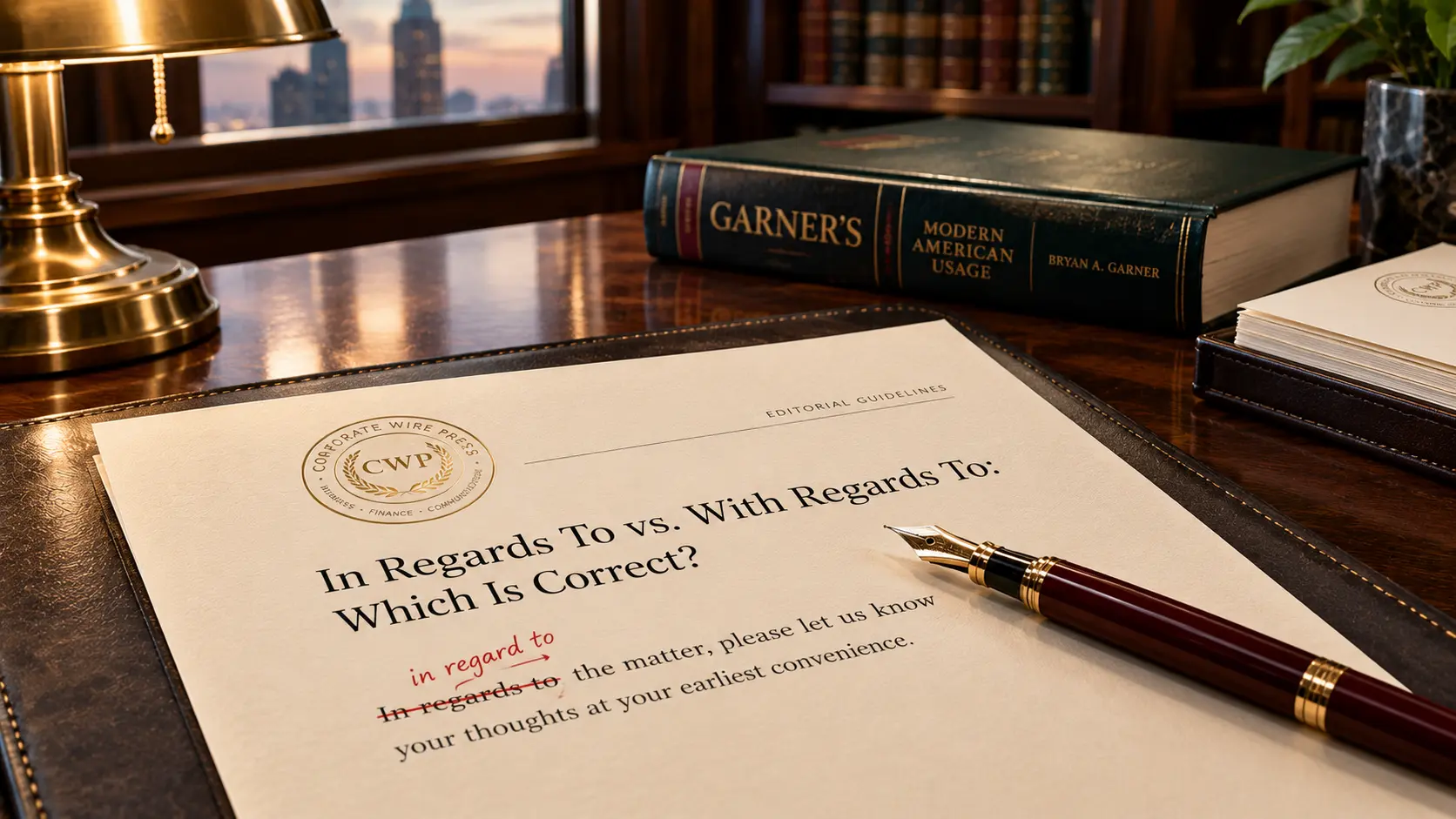
- The definitive grammatical verdict: both "in regards to" and "with regards to" (plural with an "s") are considered nonstandard, colloquial errors in formal business writing.
- The standard, widely accepted idioms in professional English are "in regard to" and "with regard to" (singular: regard, no "s"). Both singular forms are grammatically correct and interchangeable.
- The widespread confusion stems from conflating the singular noun "regard" (meaning reference, relation, or consideration) with the plural noun "regards" (meaning warm greetings or compliments).
- The phrase "as regards" is grammatically standard, but only because "regards" operates as a third-person singular present verb ("as it regards"), not a plural noun.
- Modern executive writing standards strongly favor replacing multi-word phrases ("in regard to", "with reference to") with cleaner, single-word prepositions: "regarding", "concerning", or "about".
The Definitive Verdict: In Regard To vs. With Regard To vs. The Plural Forms
If you are seeking a rapid editorial ruling before sending an executive email or finalizing an enterprise contract, here is the unvarnished verdict: neither "in regards to" nor "with regards to" is considered standard formal English. In fact, adding the terminal letter "s" to either phrase is one of the most common grammatical slip-ups flagged by professional copyeditors, legal stylists, and corporate communications officers.
The correct, time-honored, and universally accepted idioms are strictly singular: "in regard to" and "with regard to" (regard with no "s"). Both of these singular forms have occupied standard standing in prestigious English prose for centuries. Between the two, neither is inherently superior; they are stylistic twins that mean precisely the same thing: "concerning," "with reference to," or "about."
However, in contemporary business writing, an even more important question follows: why use an unwieldy, three-word prepositional phrase when a single, crisp word achieves the exact same communicative objective with greater velocity?
The Linguistic Origin of the Confusion: "Regard" vs. "Regards"
To understand why "in regards to" draws such fierce criticism from style authorities, one must examine the distinct grammatical lives of the word "regard" as a singular noun versus its plural form "regards."
When used as a singular noun, "regard" denotes relation, reference, attention, or consideration. It traces back to the Old French word "regarder" (meaning to look at or observe). Thus, when an attorney writes "with regard to section 4," they are literally saying "looking toward section 4" or "in reference to section 4." In this relational sense, the noun is strictly singular.
Conversely, the plural noun "regards" has a specialized, affective definition: it signifies sentiments of goodwill, esteem, compliments, or affectionate greetings. This is the word deployed in traditional epistolary sign-offs ("Kind regards," "Warm regards") or theatrical tributes ("Give my regards to Broadway").
Consequently, when an executive writes "I am writing in regards to your invoice," they are inadvertently committing a semantic absurdity. Translated literally, the sentence claims: "I am writing in warm affectionate greetings to your invoice." This accidental conflation of reference and affection is precisely why rigorous editorial desks reject the plural phrasing.
Comparative Evaluation: Prepositional Phrases of Reference
The spectrum of prepositional phrases used to introduce topics in corporate correspondence ranges from prestigious standard idioms to nonstandard colloquialisms and bloated corporate jargon. The following evaluation table outlines the grammatical classification, usage context, and editorial recommendation for each variation.
| Phrase | Grammatical Status | Style Guide Standing | Recommended Editorial Action |
|---|---|---|---|
| In regard to | Standard (Singular Noun) | Accepted across Chicago, AP, Oxford, and Garner | Acceptable in formal correspondence; can often be shortened to "regarding". |
| With regard to | Standard (Singular Noun) | Accepted across Chicago, AP, Oxford, and Garner | Acceptable in formal legal/executive contexts; interchangeable with "in regard to". |
| In regards to | Nonstandard / Colloquial | Universally rejected as an error in formal publishing | Avoid completely. Strike the "s" or replace with "regarding" or "about". |
| With regards to | Nonstandard / Colloquial | Rejected by traditional style manuals | Avoid in business correspondence. Use "with regard to" or "concerning". |
| As regards | Standard (Verb Construction) | Grammatically valid; formal and slightly archaic | Permissible, but often feels overly stiff. Better replaced by "concerning". |
| Regarding | Standard (Preposition/Participle) | Preferred modern executive standard | Highly recommended. Crisp, professional, and efficient. |
| Concerning | Standard (Preposition) | Widely accepted formal standard | Recommended when a slightly grave or formal tone is appropriate. |
| About | Standard (Preposition) | Gold standard for plain business English | Best choice for direct, conversational, and agile modern team communication. |
The Curious Exception: Why "As Regards" Has an "S"
Careful writers often pause when encountering the legitimate idiom "as regards." If "in regards to" is an error because of the plural "s," why is "as regards the quarterly budget" considered grammatically pristine in authoritative dictionaries?
The explanation lies in syntactic role. In the phrases "in regard to" and "with regard to," the word "regard" is an object of a preposition—a noun. Because the conceptual meaning is reference (singular), it must remain singular.
In "as regards," however, the word "regards" is not a plural noun at all. It is a third-person singular present verb in an elliptical construction: "as [it] regards the budget" (meaning "as it concerns or pertains to the budget"). Just as one writes "as it concerns," the verb form takes the third-person inflectional "-s."
While "as regards" is indisputably grammatical, modern corporate stylists generally view it as somewhat stiff, bureaucratic, and dated. In dynamic commercial prose, single-word alternatives like "regarding" or "on" deliver superior pace and clarity.
The Plain Language Movement: Why "Regarding" and "About" Win
Beyond the narrow debate over the letter "s," senior leaders and elite communicators recognize a larger stylistic principle: the fight against corporate wordiness and bureaucratic puffery.
Multi-word prepositions like "in regard to," "with reference to," "in connection with," and "pertaining to the matter of" are vestiges of nineteenth-century legal draftsmanship. Writers often instinctively reach for these multi-syllable clusters because they believe they sound weighty, formal, and authoritative. In practice, they create dead weight that slows comprehension.
Compare the economy of language in modern executive communication:
• Bloated & Nonstandard: "I am writing in regards to the revised vendor service level agreement." (12 words) • Traditional Singular: "I am writing in regard to the revised vendor service level agreement." (12 words) • Clean & Modern: "I am writing regarding the revised vendor service level agreement." (10 words) • Direct Executive Velocity: "Regarding the revised vendor agreement..." or "About the revised vendor agreement..." (6–7 words)
By pruning unnecessary syllables, your communication projects decisiveness, respect for the reader’s time, and cognitive clarity.
Real-World Workplace Rewrites: Before & After Across 5 Scenarios
To see how these principles elevate daily professional writing, examine the following five real-world corporate communication scenarios. Notice how eliminating nonstandard plurals and trimming verbose phrases sharpens each message.
| Context / Scenario | Flawed / Wordy Version (Before) | Polished Executive Version (After) | Key Editorial Improvement |
|---|---|---|---|
| Client Deliverable Notice | "We are contacting you in regards to your upcoming system deployment scheduled for next Thursday." | "We are writing regarding your upcoming system deployment scheduled for next Thursday." | Eliminated nonstandard plural "regards"; tightened introductory velocity. |
| Legal / Compliance Inquiry | "With regards to subsection B, our regulatory counsel has several compliance objections." | "With regard to subsection B, our regulatory counsel has several compliance objections." | Restored standard legal singular idiom ("with regard to") required in formal contracts. |
| Internal Team Alignment | "In regards to the Q3 headcount allocation, please submit department requests by Friday noon." | "Regarding Q3 headcount allocation, please submit department requests by Friday noon." | Replaced 4 words ("In regards to the") with 1 punchy word ("Regarding"). |
| Executive Follow-up Email | "Further to our meeting yesterday in regards to portfolio diversification, attached is the deck." | "Following yesterday's discussion about portfolio diversification, attached is the deck." | Transformed stiff legalistic jargon into crisp, natural executive English. |
| Formal Sign-off vs. Reference | "I will check in next week in regards to your availability. Best regard, Marcus." | "I will check in next week regarding your availability. Best regards, Marcus." | Corrected both errors: singularized reference ("regarding") and pluralized closing valediction ("Best regards"). |
Frequently Asked Questions About "In Regard To" vs. "With Regard To"
Here are straightforward answers to the most common queries surrounding relational prepositions and correspondence etiquette.
1. Is "in regards to" ever grammatically acceptable?
In formal, professional, academic, or published English: no. All major style manuals (Chicago, AP, Oxford, Garner) classify "in regards to" as nonstandard or incorrect. While frequently heard in casual speech and informal text messaging, using it in an executive resume, client proposal, legal brief, or company email can undermine your professional credibility.
2. Which is more formal: "in regard to" or "with regard to"?
Both phrases are equally formal, standard, and interchangeable. "With regard to" appears slightly more frequently in legal documents and academic scholarship, whereas "in regard to" is slightly more common in general corporate correspondence. You may use either without fear of stylistic error, provided you keep the noun singular.
3. What is the difference between "regarding" and "in regard to"?
"Regarding" is a single-word preposition that performs the exact same semantic function as the three-word phrase "in regard to." Modern style guides prefer "regarding" because it eliminates unnecessary syllables and quickens the pace of executive reading.
4. Can you start a sentence with "With regard to" or "In regard to"?
Yes. Both phrases function as introductory prepositional phrases. When placed at the start of a sentence, they establish the topical frame of reference and should typically be followed by a comma (e.g., "With regard to your proposal, our investment committee has reached a decision.").
5. Is "as regards" standard English?
Yes. "As regards" is grammatically standard because "regards" is functioning as a verb ("as [it] regards"), not a plural noun. However, many modern editors consider it overly formal or archaic. Substituting "regarding" or "as for" usually creates a more natural and fluid sentence.
Conclusion: Cultivating Precision in Professional Writing
Language in the business sphere is not merely a vehicle for exchanging raw data; it is an index of organizational discipline, attentiveness to detail, and intellectual rigor. While a casual reader might overlook the errant "s" in "in regards to," seasoned leaders, prospective employers, and discerning clients notice.
By internalizing the fundamental rule—singular "regard" for reference, plural "regards" for greetings—you protect your professional reputation against inadvertent colloquialisms. And by embracing crisper alternatives like "regarding" and "about," you elevate your prose from bureaucratic boilerplate to agile, persuasive executive leadership.
Sarah Jenkins is a seasoned corporate speechwriter and organizational communications strategist with 15 years of experience counseling enterprise executives, board directors, and senior leaders on high-stakes rhetoric.
Further Recommended Readings from Our Desks
Swiss FADP vs. EU GDPR: Core Legal Differences, Principles & Requirements Explained
A foundational legal analysis examining the core philosophical doctrines, statutory principles, consent standards, and governance requirements that distinguish Swiss data protection law from the EU GDPR.
Swiss-US Data Privacy Framework vs. EU GDPR: Cross-Border Data Transfers for AI Systems
A technical and regulatory analysis of transatlantic data transfers for artificial intelligence platforms, comparing the Swiss-U.S. Data Privacy Framework with EU GDPR transfer mechanisms, Standard Contractual Clauses, and sovereign cloud infrastructure.
Implications of Swiss Privacy Law & GDPR for AI Companies: Strategy, Risks & Market Access
Strategic analysis for machine learning executives, venture-backed AI labs, and enterprise SaaS providers evaluating jurisdictional advantages, cross-border liabilities, and European market expansion.