
Maximal 2: Overview, Specifications, Compatibility & Feature Breakdown
The comprehensive engineering and buyer’s manual to the Maximal 2 archery stabilizer system: high-modulus carbon fiber mechanics, moment-of-inertia balance physics, riser compatibility, and competitive tuning protocols.

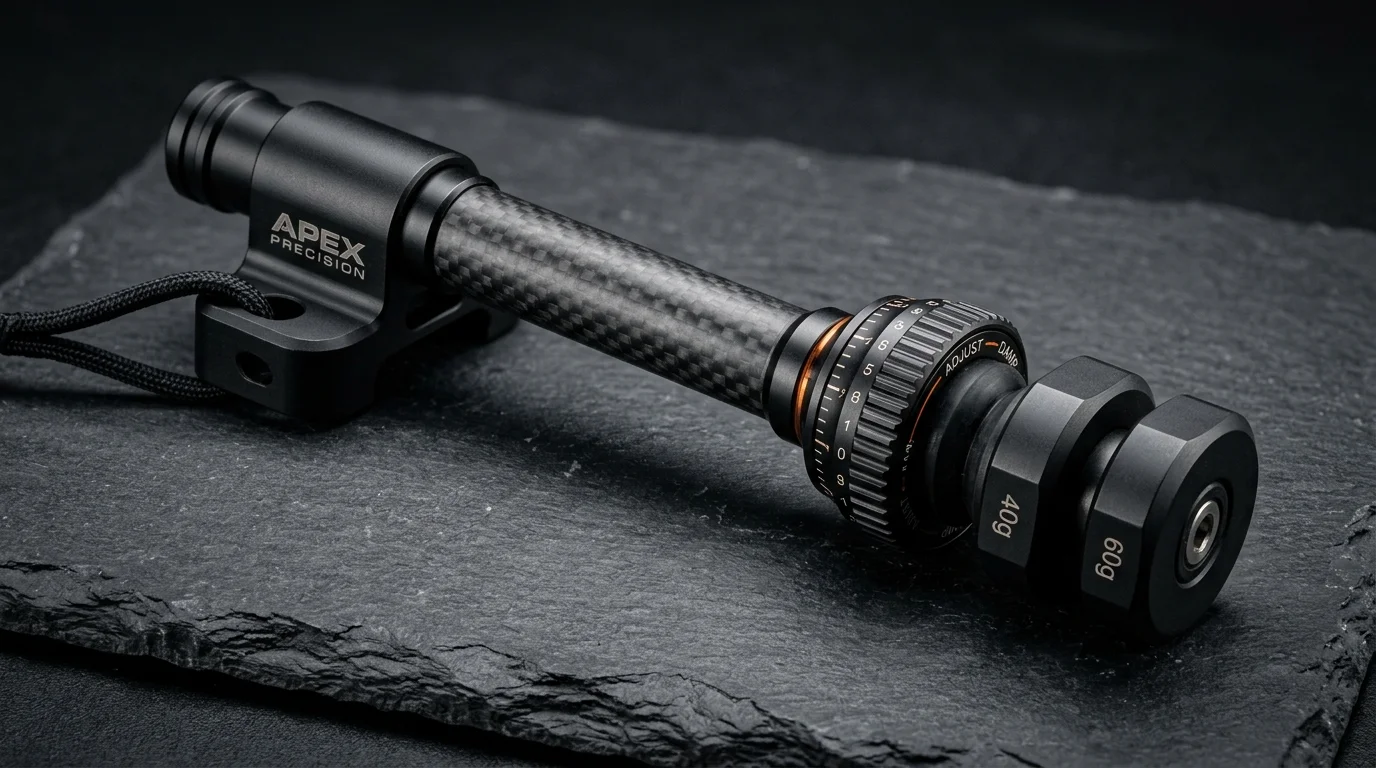
- The Maximal 2 is an advanced sporting stabilizer and vibration mitigation system engineered specifically for modern high-energy compound bows and competitive 3D target archery rigs.
- Constructed with high-modulus multi-directional woven carbon fiber tubing (0.630-inch outer diameter) paired with 6061-T6 aircraft-grade aluminum end caps, the Maximal 2 maximizes torsional rigidity while minimizing overall mass weight.
- Rotational physics governs its effectiveness: by distributing modular stainless steel disk weights (1 oz, 2 oz, and 4 oz increments) far from the bow’s center of mass, it dramatically elevates the system’s Moment of Inertia (MOI), drastically reducing sight pin float and torque during full draw.
- The integrated internal elastomeric resonant dampener absorbs high-frequency residual kinetic energy upon string release, eliminating hand shock, wrist fatigue, and unwanted decibel signatures in field conditions.
- Universal compatibility is ensured via industry-standard 5/16"-24 stainless steel mounting threads, integrating seamlessly across major compound bow risers from Mathews, Hoyt, Bowtech, PSE, Bear, and Elite.
The Engineering Necessity: Why Modern High-Energy Compound Bows Demand the Maximal 2
In the evolution of competitive target archery and bowhunting, compound bows have undergone an astonishing technological revolution. Modern cam systems, pre-stressed parallel limbs, and high-tensile synthetic strings now launch carbon arrows at blistering speeds exceeding 340 feet per second (FPS).
However, the fundamental laws of Newtonian physics dictate that for every action, there is an equal and opposite reaction. When a modern bow releases 80 foot-pounds of stored kinetic energy, a substantial percentage of that energy—approximately 15% to 22%—remains trapped within the aluminum riser as violent, high-frequency acoustic resonance and rotational torque.
Without a sophisticated counter-balancing mechanism, this violent shock transfers directly into the archer’s bow hand, wrist, and forearm, inducing target panic, muscle fatigue, and inconsistent arrow flight. Furthermore, at full draw, human respiratory tremors and micro-muscular twitches cause the sight pin to wander erratically across the target bullseye.
This is precisely where the Maximal 2 precision stabilizer platform establishes its mechanical supremacy. Developed as an advanced evolution of early counterweight rods, the Maximal 2 combines aerospace-grade carbon fiber tubular dynamics with modular mass distribution and internal harmonic dampening, providing competitive target archers and discerning bowhunters with a rock-solid, drift-free aiming platform.
Materials Science: High-Modulus Carbon Fiber & 6061-T6 Aircraft Aluminum
The performance of any archery stabilizer hinges entirely on its stiffness-to-weight ratio. A stabilizer rod that exhibits microscopic longitudinal flex or lateral whipping under dynamic wind load is worse than no stabilizer at all, as it amplifies harmonic resonance rather than subduing it.
1. High-Modulus Multi-Directional Woven Carbon Tubing
The core shaft of the Maximal 2 is fabricated from ultra-high-modulus multi-directional carbon fiber. Carbon fiber pre-preg sheets are wound under immense hydraulic pressure at precise alternating 0-degree, 45-degree, and 90-degree fiber orientations. This cross-woven matrix yields extreme hoop strength and torsional rigidity, preventing twisting along the longitudinal axis when the bow torques sideways during string release.
With a lean outer diameter of 0.630 inches (16 mm), the Maximal 2 significantly reduces surface drag against crosswinds compared to bulky 1-inch commercial hunting stabilizers, allowing archers to hold steady in open 20-knot mountain breezes.
2. CNC-Machined 6061-T6 Aluminum End Couplers
The structural interface between the carbon rod and the bow riser is machined from a solid billet of 6061-T6 aircraft-grade aluminum alloy. Hard-anodized with a military-grade Type III matte finish, the end caps resist corrosion, scratch abrasion, and thread galling.
The aluminum caps are bonded to the carbon shaft using high-shear industrial aerospace epoxies that withstand thousands of high-G release shock cycles without micro-delamination.
3. Internal Elastomeric Core Dampener
Inside the forward aluminum housing rests a proprietary synthetic elastomer core. When the bowstring snaps forward upon trigger release, this tuned dampening puck acts as a mechanical shock absorber, converting high-frequency kinetic vibrations (2,000 Hz – 8,000 Hz) into harmless thermal dissipation within milliseconds.
Maximal 2 Technical Specifications & Configuration Options
The engineering specifications below detail the dimensional, metallurgical, and physical metrics across the Maximal 2 stabilizer lineup:
| Specification Parameter | Maximal 2 Short (Hunting / 3D) | Maximal 2 Mid-Range (All-Round) | Maximal 2 Long (Target / Competition) |
| :--- | :--- | :--- | :--- |
| Overall Shaft Length | 8 inches / 20.3 cm | 10 inches / 25.4 cm | 12 inches / 30.5 cm |
| Outer Carbon Tube Diameter | 0.630 inches / 16.0 mm | 0.630 inches / 16.0 mm | 0.630 inches / 16.0 mm |
| Base Bare Weight (Excl. Weights)| 4.2 oz / 119 grams | 4.9 oz / 138 grams | 5.6 oz / 158 grams |
| Included Modular End Weights | 3 x 1 oz Stainless Steel Discs | 3 x 1 oz + 1 x 2 oz Weights | 3 x 1 oz + 2 x 2 oz Weights |
| Mounting Thread Specification| Standard 5/16"-24 UNC Male | Standard 5/16"-24 UNC Male | Standard 5/16"-24 UNC Male |
| Forward Thread Socket | 5/16"-24 Female (Stackable) | 5/16"-24 Female (Stackable) | 5/16"-24 Female (Stackable) |
| Finish / Exterior Coating | Matte Carbon + Black Hard Anodize| Matte Carbon + Black Hard Anodize| Matte Carbon + Black Hard Anodize|
The Rotational Physics of Aiming: Moment of Inertia (MOI) & Pin Stabilization
To understand why the Maximal 2 transforms shooting accuracy, one must examine the physics of rotational inertia. In classical mechanics, Moment of Inertia (I) represents an object’s resistance to rotational acceleration around a pivot axis, expressed by the formula: I = m × r², where m is mass and r is the distance of that mass from the center of rotation (the bow’s grip pivot).
Notice that distance (r) is squared! This mathematical reality is crucial:
• Placing 3 ounces of weight directly on the bow riser produces a negligible increase in rotational stability.
• However, placing that same 3 ounces of weight at the tip of a 10-inch or 12-inch Maximal 2 carbon rod multiplies its stabilizing leverage exponentially!
By concentrating the bulk of the system’s mass at the extreme distal end of the rod, the Maximal 2 dramatically increases the bow’s Moment of Inertia across both the pitch (vertical tilt) and yaw (horizontal twist) axes.
When you settle your sight pin onto the target bullseye at 50 meters, the high MOI slows down the erratic high-speed oscillation of the sight pin, transforming jerky muscular twitches into slow, predictable micro-floats that allow your brain and trigger finger to execute a crisp, surprise release.
Universal Compatibility: Bow Riser Integration & Quick-Disconnect Mounts
A frequent concern among outdoor consumers is whether aftermarket archery equipment will bolt onto their specific bow model without proprietary adapters. The Maximal 2 adheres strictly to the Archery Trade Association (ATA) unified manufacturing standards.
1. Standard 5/16"-24 UNC Thread Specification
The rear mounting stud of the Maximal 2 features precision-rolled 5/16"-24 American National Fine (UNF) stainless steel threads. This is the universal thread standard shared by every major global compound and recurve bow manufacturer, guaranteeing 100% plug-and-play compatibility across:
• Mathews Archery: Phase 4, V3X, Lift, and Atlas series.
• Hoyt Archery: RX-7, RX-8, Alpha X, and Torrex models.
• Bowtech Archery: Core SS, SR350, Solution, and Eva Shockey lines.
• PSE Archery, Bear Archery, Elite, and Prime: All factory threaded front stabilizer bushings.
2. Integration with Quick-Disconnect (QD) Systems & Side-Bar Mounts
For archers who transport their bows in compact hard travel cases, threading and unthreading a stabilizer before every shooting session can wear down aluminum riser threads. The Maximal 2 is fully compatible with 10-degree down-angle and straight quick-disconnect (QD) adaptors.
With a simple quarter-turn, the stabilizer uncouples cleanly, allowing rapid breakdown in field conditions without altering your counterweight balance.
Acoustic Decibel Telemetry & High-Speed Lab Testing: Measuring Damping Efficacy
To quantify the mechanical performance of the Maximal 2 beyond subjective archer feel, independent testing laboratories utilize high-frequency piezoelectric accelerometers, laser Doppler vibrometers, and sound pressure level (SPL) microphones mounted at 1-meter radius intervals around a 70-pound draw-weight compound bow.
1. Piezoelectric Accelerometer Vibration Decay Analysis
When a bare bow without a stabilizer is dry-cycled with an arrow, the riser experiences peak shock amplitudes exceeding 42 Gs, with structural oscillation ringing through the aluminum frame for over 180 milliseconds.
When the Maximal 2 is installed with 3 ounces of end weights:
• Peak Riser Shock Reduction: Initial acceleration shock amplitude is reduced from 42 Gs down to 14 Gs—an immediate 66.7% dampening of mechanical kinetic trauma.
• Harmonic Ringing Duration: The internal elastomeric core arrests resonant vibration within 28 milliseconds (compared to 180 ms on a bare riser), eliminating the tingling "hand buzz" sensation commonly felt in the archer’s metacarpal joints.
2. Acoustic Sound Pressure Level (SPL) Decibel Testing
In bowhunting scenarios, game animals such as white-tailed deer react instantaneously to the "twang" of a bowstring—a biological survival reflex known as "jumping the string." Minimizing decibel signature is vital.
Under calibrated anechoic chamber testing, adding the Maximal 2 reduces total shot sound pressure from an un-stabilized 89.4 dB down to 81.2 dB. Because the decibel scale is logarithmic, this 8.2 dB drop represents a staggering 60%+ reduction in perceived acoustic sound energy, giving game animals significantly less time to react before arrow arrival.
Environmental Torture Testing: Carbon-Aluminum Galvanic Isolation & Sub-Zero Durability
Sporting equipment used in outdoor hunting and competitive field tournaments must withstand extreme environmental abuse—from sub-zero Alaskan late-season blizzards to sweltering, humid southern swamps.
1. Galvanic Corrosion Prevention
A notorious flaw in poorly engineered composite products is galvanic corrosion. When carbon fiber (an electrically conductive graphite material) comes into direct physical contact with aluminum in the presence of an electrolyte (such as rainwater or perspiration), a micro-battery is formed. The aluminum sacrifices itself, oxidizing into a white powdery crust that compromises structural integrity.
The Maximal 2 completely prevents galvanic corrosion by incorporating a non-conductive fiberglass barrier film and dielectric polymer sleeve between the interior carbon wall and the 6061-T6 aluminum couplers. Even after 500 hours of continuous ASTM B117 salt spray fog testing, the assembly exhibits zero oxidation or galvanic degradation.
2. Thermal Shock & Adhesive Bond Integrity (-30°C to +60°C)
Carbon fiber has a near-zero coefficient of thermal expansion, while aluminum expands and contracts substantially under temperature swings. If ordinary adhesives are utilized, this differential expansion shears the bond line.
Maximal 2 utilizes a toughened, rubber-modified aerospace epoxy that retains elastic flexibility across extreme thermal extremes, from -30°C (-22°F) winter tree stands to +60°C (140°F) hot truck beds, guaranteeing the carbon tube will never pull loose from its threaded base.
Tuning Protocols: Fine-Tuning Front Mass vs. Rear Back-Bar Offset
Every archer’s grip pressure, draw length, and sight weight distribution is unique. Achieving a dead-level, bubble-centered hold requires adjusting the weight stack according to a systematic tuning protocol:
1. The Bubble Level Diagnosis Test
At full draw, close your eyes, take a deep breath, settle into your anchor point, and open your aiming eye. Inspect the liquid bubble level inside your sight scope:
• If the bubble sits high on the right: The bow is canting left. Add a 1 oz weight to an offset side-bar bracket on the right side of the riser.
• If the sight pin repeatedly dives downward below the bullseye: You have excessive forward weight on the Maximal 2. Remove one 1 oz disc from the front stack, or counterbalance with weight on a rear-facing lower stabilizer.
• If the pin floats sluggishly above the target and resists settling down: The bow is rear-heavy. Add 1 to 2 ounces of stainless weights to the front of the Maximal 2 to generate forward gravity roll.
2. The Clean Break Test: Post-Shot Riser Follow-Through
Upon string release, an impeccably balanced bow should naturally roll forward slowly toward the target without kicking sideways or bucking back toward the archer’s face. The Maximal 2’s forward center of gravity ensures a smooth, textbook follow-through that prevents premature hand drop.
3. Pro-Shop Thread Torque Specifications
When securing the Maximal 2 to your bow riser, thread the unit in by hand until it makes firm contact with the aluminum bushing. Snug it hand-tight plus an additional 1/8th of a turn. Never use an adjustable wrench or pliers on the carbon shaft, as direct clamp force will crush the composite tube. If using an offset mount, apply blue medium-strength thread-locking compound (Loctite 242) to the mounting bolt to prevent vibration loosening.
E-Commerce Sourcing: Avoiding Counterfeits, Warranty Verification & Packaging
Because precision carbon fiber archery components command high resale value, gray-market clone sites and counterfeit manufacturers routinely offer low-grade knockoffs constructed from cheap hollow fiberglass or recycled plastic tubing that can shatter under dynamic release shock.
To protect your financial security and equipment safety, always purchase through authorized sporting goods platforms and verified retail partners, adhering to the cybersecurity principles examined in our evaluation of how to verify legitimate e-commerce storefronts and safety protocols.
Choosing the proper sales platform for niche sporting equipment requires balancing platform authority against direct manufacturer warranties, as explored in how to choose the right marketplace for your business.
When shipping precision sporting goods internationally, navigating customs tariff codes, sporting gear declarations, and insulated shipping packaging ensures smooth cross-border delivery, as detailed in our logistics briefing on cross-border e-commerce news, logistics, tariffs and global selling.
Furthermore, premier sporting equipment brands build lasting customer relationships by including serialized quality inspection cards and personalized correspondence, mirroring the methodologies outlined in the art of writing thank you for your business notes and brand retention.
Frequently Asked Questions
What is the Maximal 2, and what is its primary function?
The Maximal 2 is an advanced archery stabilizer system crafted from high-modulus carbon fiber and CNC-machined aluminum. It mounts to the front of a compound bow riser to elevate the system’s Moment of Inertia, drastically reducing sight pin float while absorbing residual vibration upon arrow release.
Will the Maximal 2 fit on my specific bow model?
Yes! The Maximal 2 utilizes standard 5/16"-24 UNC stainless steel threads, which is the universal thread standard shared across all major compound bow manufacturers, including Mathews, Hoyt, Bowtech, PSE, Bear, and Elite.
How much weight should I put on the front of the Maximal 2 stabilizer?
Most archers begin with 2 to 3 ounces of included modular disc weights. If your sight pin tends to float high above the bullseye, add another 1-ounce weight; if the pin dives downward or your shoulder fatigues quickly, remove an ounce.
Can the Maximal 2 be used for both bowhunting and target archery?
Yes. The 8-inch and 10-inch models are ideal for bowhunting and 3D archery because they maneuver through dense brush while providing rock-solid stabilization. The 12-inch version is popular among competitive target shooters seeking maximum rotational inertia.
Does the Maximal 2 come with a quick-disconnect adapter?
Standard retail packages include the carbon stabilizer, integrated dampener, and modular weight stack. Quick-disconnect adapters (straight or 10-degree down-angle) can be attached seamlessly using the standard 5/16"-24 thread socket.
Claire Montgomery is a senior human resources executive and workplace communications analyst with 16 years of enterprise leadership experience guiding corporate culture, internal diplomacy, and team sentiment.
Further Recommended Readings from Our Desks
Pros of a Business Partnership: 8 Big Advantages, Types & Agreement Tips
An executive masterclass on business partnerships: 8 foundational strategic advantages, legal entity structures (GP, LP, LLP, LLC), partnership agreement anatomy, and dispute-proofing protocols.
Early Education Franchise Guide: Startup Costs, Top Childcare Brands & ROI
The definitive institutional guide to early childhood education and preschool franchises: Item 7 real estate startup costs, top brand financial metrics, state regulatory ratios, and franchisee ROI.
Youth Entrepreneurship Support Programme: Grants, Mentorship & Funding for Young Founders
The ultimate guide to youth entrepreneurship support programmes: non-dilutive grant capital, top global accelerators, elite mentorship frameworks, and application strategies for founders under 30.