
What Is MHRB? (Mimosa Hostilis Root Bark): Botanical Uses, Natural Dyeing & Sourcing
The comprehensive scientific and artisan guide to Mimosa Hostilis Root Bark (MHRB): phytochemistry, natural anthocyanin and tannin textile dyeing, regenerative harvesting, and e-commerce sourcing authenticity.

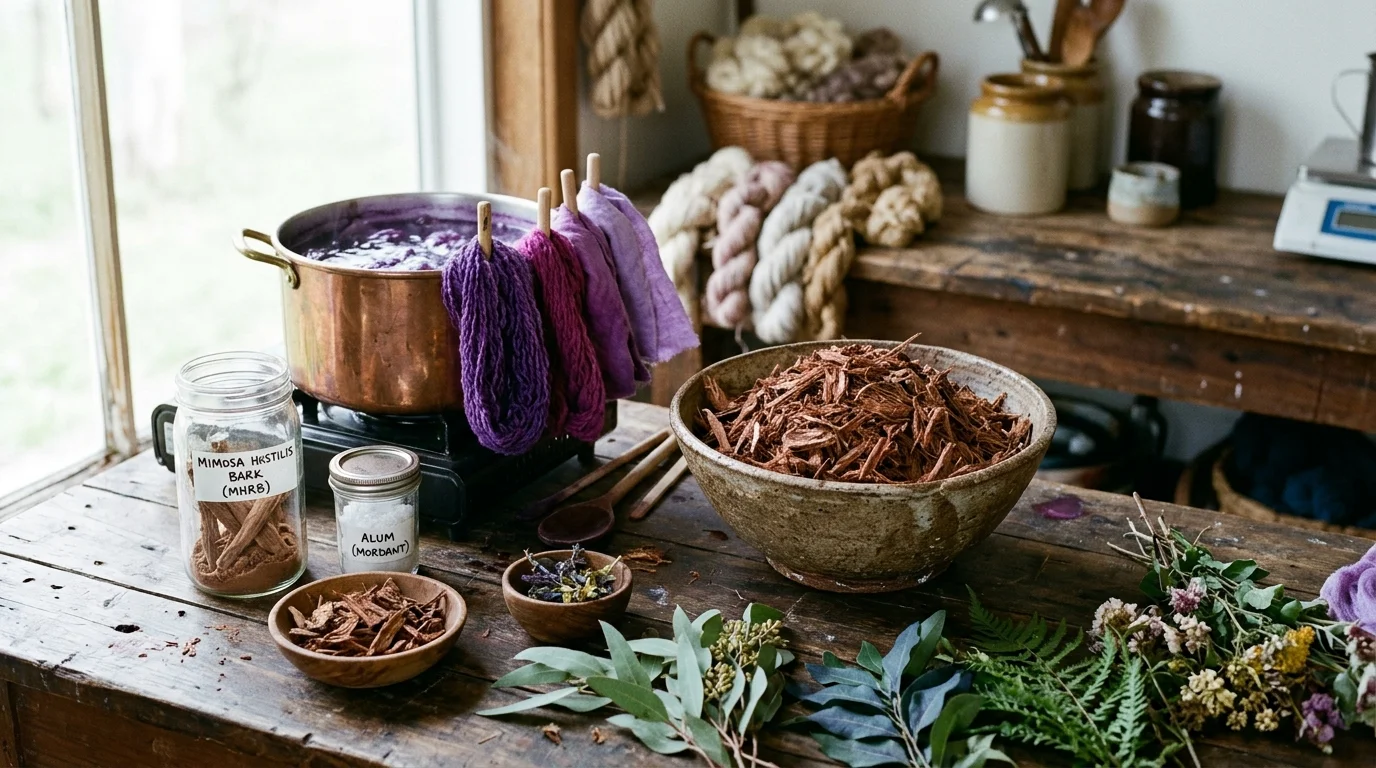
- MHRB stands for Mimosa Hostilis Root Bark—the dried, fibrous inner root cortex harvested from Mimosa tenuiflora (syn. Mimosa hostilis), a resilient perennial tree native to the Caatinga drylands of Northeastern Brazil and Southern Mexico.
- In traditional Mesoamerican and South American herbalism, the bark is revered as Tepezcohuite in Mexico (celebrated as the "skin tree" for its remarkable dermal regeneration and burn soothing properties) and Jurema Preta in Brazil.
- For sustainable textile artisans, MHRB is prized as an extraordinary natural dye substrate, yielding deep purples, blush pinks, and earthy terracotta reds due to its immense concentration of condensed tannins (16% to 20%) and natural polyphenols.
- Regenerative wildcrafting practices are essential: ethical harvesters excavate only lateral non-vital roots, leaving the primary taproot intact to ensure the perennial tree survives and prevents soil erosion in fragile arid biomes.
- Sourcing authentic MHRB online requires navigating strict botanical customs regulations, testing for inner-bark fibrous purity versus adulterated outer-trunk filler, and demanding verifiable phytosanitary certificates.
Botanical Taxonomy & Indigenous Origins: The Legend of Mimosa Hostilis
In the global resurgence of ethnobotany, green chemistry, and sustainable textile crafts, few natural botanical materials have garnered as much international fascination and commercial attention as MHRB—the industry acronym for Mimosa Hostilis Root Bark.
Botanically cataloged today as Mimosa tenuiflora (with Mimosa hostilis recognized in biological nomenclature as its primary homotypic synonym), this thorny, leguminous deciduous tree belongs to the Fabaceae (pea) botanical family. Reaching mature heights between 4 and 8 meters, the tree thrives in the semi-arid Caatinga scrubland biome of Northeastern Brazil, as well as the dry deciduous forests of Chiapas and Oaxaca in Southern Mexico, Colombia, and Venezuela.
For centuries, indigenous populations have revered this resilient tree under different regional titles:
• Tepezcohuite in Mexico: Derived from the indigenous Nahuatl word tepexohuitl (literally translating to "metal-tree of the hill," referencing its extraordinarily hard, dense wood), Mexican traditional healers utilized the crushed bark as an indispensable miracle balm for severe thermal burns, diabetic foot ulcers, abrasions, and skin lesions. Following the catastrophic 1984 San Juanico LPG refinery explosions in Mexico City, Red Cross medical personnel famously administered pulverized Tepezcohuite bark powder to treat hundreds of severe burn victims when pharmaceutical burn ointments were exhausted, leading to widespread clinical research into its dermal regenerative efficacy.
• Jurema Preta in Brazil: In the arid Sertão drylands of Brazil, the tree is known as Jurema Preta. Afro-Indigenous spiritual traditions, such as O Culto da Jurema and Catimbó, hold the tree sacred, weaving its roots and bark into communal healing rituals, cultural lore, and sacred herbal teas that symbolize perseverance and resistance against harsh desert climates.
The Extreme Ecology of the Caatinga Scrubland
The biochemical richness of MHRB is an evolutionary response to one of the most punishing microclimates on Earth. The Brazilian Caatinga experiences erratic, prolonged droughts lasting nine months or more, during which ground temperatures regularly exceed 45°C (113°F). To survive in nutrient-poor hyper-saline soils, Mimosa tenuiflora forms specialized symbiotic root nodules with nitrogen-fixing Rhizobium bacteria.
The deep root network synthesizes condensed tannins as an impervious natural armor to resist subterranean fungal rot, parasitic nematodes, and moisture desiccation. When artisans harvest this root bark, they are utilizing an evolutionary miracle of arid resilience.
In contemporary international commerce, MHRB has gained worldwide prominence among artisan textile dyers, soap artisans, herbal skincare formulators, and leather tanning purists who seek rich, colorfast botanical pigments free of toxic synthetic petroleum aniline dyes.
Phytochemical Architecture: Tannins, Saponins & Bioactive Constituents
The remarkable functional versatility of Mimosa Hostilis Root Bark stems from its intricate phytochemical composition, developed by the tree over millennia as a biochemical defense mechanism against arid drought, intense ultraviolet radiation, and herbivorous insects:
1. Condensed Tannins (Proanthocyanidins) – 16% to 20%
The most prominent chemical component of MHRB is its immense concentration of condensed tannins (catechin and gallocatechin oligomers). Tannins are water-soluble astringent polyphenolic polymers capable of precipitating alkaloids, gelatin, and other proteins. This sky-high tannin density gives MHRB its natural antimicrobial, astringent, and preservative qualities, making it historically indispensable in natural leather tanning and wood preservation.
2. Triterpenoid Saponins (Mimososides)
The root bark contains unique triterpenoid saponins—often designated as mimososides A, B, and C. In dermatological and cosmetic research, these natural surfactant saponins demonstrate remarkable wound-healing stimulation, promoting fibroblast proliferation, accelerating tissue collagen synthesis, and boosting cellular microcirculation.
3. Bioflavonoids, Lipids & Phytosterols
Rich in natural bioflavonoids (including chalcones, lupeol, and campesterol), MHRB provides potent free-radical scavenging capacity. These antioxidants protect organic fibers and skin tissues from atmospheric oxidation, reinforcing its value in natural cosmetic formulations and anti-aging skincare balms.
Rigorous testing for botanical purity and bioactive potency requires the same rigorous laboratory chromatography standards applied across modern herbal products, as analyzed in our consumer evaluation of botanical purity and quality standards in natural wellness products.
MHRB Chemical Composition & Botanical Anatomy Matrix
The table below illustrates the phytochemical partitioning between the inner root bark, outer trunk bark, and interior heartwood of Mimosa tenuiflora:
| Botanical Part | Condensed Tannin Content | Pigment Yield & Color Profile | Saponin Concentration | Commercial Artisan Grade | Primary Application |
| :--- | :--- | :--- | :--- | :--- | :--- |
| Inner Root Bark (MHRB) | 16% – 22% (Ultra-High) | Deep Purple, Magenta, Violet | High (Mimososides A & B) | Premium Grade A+ | Textile dyeing, fine soapmaking, herbal cosmetics |
| Outer Root Cortex | 8% – 12% (Moderate) | Dull Brick Red, Muddy Brown | Moderate | Grade B Utility | Rustic leather tanning, coarse wool dyeing |
| Trunk / Stem Bark | 6% – 9% (Low) | Pale Brown, Tan, Ochre | Low to Trace | Lower Industrial Grade | Timber preservation, charcoal, soil mulch |
| Heartwood (Core Wood) | < 1% (Trace) | Faint Yellow, Non-Staining | Negligible | Non-Dye Byproduct | Furniture timber, fence posts, firewood |
The Science of Natural Textile Dyeing: Extraction Chemistry & Fiber Mordanting
For natural textile artisans and slow-fashion practitioners, MHRB is celebrated as one of the very few botanical dye sources capable of yielding vibrant, lightfast purple and violet tones without relying on toxic heavy metal synthetic fixatives.
1. Fiber Preparation and Protein vs. Cellulose Mordanting
To achieve permanent color bonding that withstands repeated laundering, raw fibers must be properly scoured and mordanted:
• Protein Fibers (Wool, Alpaca, Silk): Protein fibers possess natural amino acid receptor sites. Mordant raw wool skeins by simmering them gently for 60 minutes in a 12% Weight of Fiber (WOF) solution of Potassium Aluminum Sulfate (Alum). Alum creates microscopic coordination bonds between the fiber molecules and the botanical tannins.
• Cellulose Fibers (Cotton, Linen, Hemp): Plant fibers lack protein receptor sites. To dye organic cotton or linen with MHRB, fibers must undergo a two-step process: first, tannin-pre-treatment using oak gall tannin, followed by an aluminum acetate mordant bath.
2. Extraction Temperature and pH Modulation
The final color hue obtained from MHRB is exquisitely sensitive to extraction temperature and water pH:
• The Acidic Extraction (Deep Magenta & Berry Red): Adding a teaspoon of citric acid or white vinegar to lower the dye bath pH to 4.5 – 5.0 stabilizes anthocyanin pigments, yielding radiant magenta, raspberry, and dusty rose hues on silk and merino wool.
• The Alkaline Extraction (Rich Purple, Plum & Slate Violet): Shifting the dye bath to a slightly alkaline pH (8.0 – 8.5) by adding a small pinch of washing soda (sodium carbonate) alters the molecular geometry of the tannins, coaxing out dramatic deep plum, eggplant, and violet tones.
• Iron Saddening (Dark Charcoal & Espresso Brown): Dipping dyed yarn into a 1% ferrous sulfate (iron) after-bath "saddens" the color, transforming rich purple into an intense, brooding gunmetal gray or dark espresso brown.
3. Step-by-Step Artisan Dye Bath Recipe (100g Wool Skein)
1. Measure: Weigh 100g of dry, pre-mordanted wool yarn. Measure out 50g of shredded MHRB (50% WOF for medium saturation, 100% WOF for deep midnight violet).
2. Simmer Extraction: Place shredded MHRB in a stainless steel dye pot with 3 liters of water. Heat gently to 80°C (175°F) for 90 minutes. Do not boil vigorously, as excessive heat can scorch the tannins and turn the dye bath muddy brown.
3. Strain: Strain the liquid through fine cheesecloth to remove bark fibers, collecting the jewel-toned liquid back into the pot.
4. Dye: Submerge damp, pre-mordanted yarn into the warm bath. Maintain a gentle simmer (75°C – 80°C) for 60 minutes, stirring gently to ensure even dye absorption.
5. Cool & Cure: Allow the yarn to cool completely inside the dye pot overnight. This slow thermal cooling allows tannin molecules to penetrate deep into the yarn core.
6. Rinse & Dry: Wash thoroughly in lukewarm water with a pH-neutral botanical soap until the water runs crystal-clear, then hang in the shade to dry.
Artisan Soapmaking & Cosmetic Balms: Formulating with Tepezcohuite Powder
Beyond fiber dyeing, MHRB powder (Tepezcohuite) is an extraordinarily popular additive in cold-process artisan soapmaking, handcrafted facial salves, and restorative botanical balms.
1. Cold-Process Soapmaking Mechanics
In artisan saponification, powdered MHRB acts both as a natural deep-plum colorant and an exfoliating, skin-soothing agent:
• Lye Solution Infusion: When creating lye water (sodium hydroxide dissolved in distilled water), superfine micronized MHRB powder can be added directly to the hot lye. The intense alkaline reaction (pH 13+) triggers instant chromophoric transformation, turning the mixture a rich, dark aubergine purple that persists through the full saponification cure.
• Gentle Exfoliation: The fine botanical fibers provide physical micro-dermabrasion that clears dead keratinocytes without causing micro-tears on sensitive facial skin.
2. Restorative Herbal Balms and Salves
Cosmetic formulators infuse shredded MHRB into carrier oils (such as organic cold-pressed jojoba or sweet almond oil) using a low-temperature double boiler for 6 to 8 hours. The infused ruby-tinted oil is blended with organic yellow beeswax, unrefined shea butter, and vitamin E to create protective skin barrier ointments that soothe dry eczema, cracked cuticles, and sun-exposed skin.
Understanding plant morphology and botanical lipid properties is essential when selecting natural ingredients for holistic wellness, echoing the principles analyzed in our examination of plant anatomy and botanical classifications in the food and agricultural trade.
Sourcing Ethics & Regenerative Wildcrafting: Protecting Arid Ecosystems
As global demand for natural botanicals surges, the ethical harvesting of wild tree roots has become a pressing environmental issue. Destructive harvesting practices—such as clear-felling mature trees or severing central vertical taproots—kill the plant and accelerate catastrophic desertification in the fragile Brazilian Caatinga.
1. Regenerative Lateral Root Harvesting
Responsible indigenous and cooperative harvesters practice strictly non-lethal lateral root excavation:
• Only mature trees (at least 5 to 7 years old) with a trunk diameter exceeding 15 cm are selected.
• Harvesters dig carefully 1 to 2 meters away from the tree base, uncovering secondary shallow lateral roots.
• Only one or two lateral roots per tree are cleanly harvested using sanitized pruning saws. The central vertical taproot is never touched, ensuring the tree retains its deep water access.
• The excavation trench is immediately backfilled with native soil, organic leaf mulch, and compost, allowing the tree to regenerate harvested lateral roots within 24 to 36 months.
2. Fair-Trade Cooperative Economics
Ethical e-commerce brands partner directly with rural agricultural cooperatives in Brazil and Mexico, ensuring harvesters receive livable, above-market wages. This economic empowerment prevents local communities from clearing native forests for cattle ranching or monoculture farming, transforming the living forest into an economically viable, preserved sanctuary.
E-Commerce Authentication & Customs Compliance: Navigating Global Botanical Trade
Sourcing and retailing authentic MHRB online involves navigating complex global regulatory frameworks and supply chain verifications.
1. Identifying Counterfeits & Trunk Bark Adulteration
Because inner root bark is labor-intensive to harvest, unscrupulous suppliers routinely adulterate products by grinding cheap outer trunk bark, saw dust, and stem wood together:
• Color and Texture: Authentic shredded MHRB displays a striking fibrous texture with rich reddish-purple interior striations. If the material looks dull beige, grayish-brown, or crumbly like garden woodchips, it is heavily adulterated with trunk wood.
• Smell: Pure MHRB possesses a distinctive, pleasant, sweet-earthy aroma reminiscent of black tea, dried dates, and damp forest loam. A sour, chemical, or rancid smell indicates mold or chemical bleaching.
2. International Agricultural Shipping & Customs Regulations
Importing raw botanical root bark across international borders requires rigorous compliance with USDA-APHIS (in the United States), EFSA (in the European Union), and national biosecurity agencies. Shipments must be accompanied by official Phytosanitary Certificates certifying that the plant material is kiln-dried, free of soil contaminants, and clear of invasive agricultural pests.
For e-commerce merchants managing cross-border botanical distribution, understanding agricultural tariff codes, customs clearance documentation, and carrier compliance is paramount, as detailed in our global supply chain briefing on cross-border e-commerce news, logistics, tariffs and global selling.
Furthermore, independent botanical merchants must thoughtfully evaluate sales platforms that support niche agricultural products without erratic algorithmic de-platforming, a crucial consideration explored in how to choose the right marketplace for your business.
Finally, sustainable botanical brands build devoted customer followings by including detailed educational inserts, provenance certificates, and personalized notes inside every order, adhering to the principles outlined in the art of writing thank you for your business notes and sustainable customer retention.
Frequently Asked Questions
What does the acronym MHRB stand for?
MHRB stands for Mimosa Hostilis Root Bark. It is the dried, fibrous cortex of the root of the Mimosa tenuiflora (syn. Mimosa hostilis) tree, native to Northeastern Brazil and Southern Mexico.
What colors can you dye fabric using MHRB?
MHRB produces a versatile spectrum of natural colors depending on water pH and mordants: radiant magenta and dusty rose under slightly acidic conditions (pH 4.5-5.0), deep purple and slate violet under alkaline conditions (pH 8.0-8.5), and rich espresso brown or charcoal when saddened with iron sulfate.
Is MHRB the same plant as Tepezcohuite?
Yes! Tepezcohuite is the traditional Mexican and Nahuatl name for Mimosa tenuiflora. In Mexico, it is famous for its dermatological properties, used extensively in natural skincare creams, burn balms, and regenerative soaps.
How do you know if MHRB is high quality and authentic?
Authentic high-grade MHRB consists of dark reddish-purple, stringy inner root fibers with a sweet, earthy, tea-like aroma. Low-grade or counterfeit bark appears pale brown or beige, resembling chopped mulch with minimal dye pigment.
Does harvesting MHRB kill the tree?
When performed by ethical, regenerative harvesters, no. Sustainable harvesters only uncover and trim secondary lateral roots from mature trees, leaving the central taproot undisturbed and backfilling the soil so the tree continues to thrive.
Claire Montgomery is a senior human resources executive and workplace communications analyst with 16 years of enterprise leadership experience guiding corporate culture, internal diplomacy, and team sentiment.
Further Recommended Readings from Our Desks
Pros of a Business Partnership: 8 Big Advantages, Types & Agreement Tips
An executive masterclass on business partnerships: 8 foundational strategic advantages, legal entity structures (GP, LP, LLP, LLC), partnership agreement anatomy, and dispute-proofing protocols.
Early Education Franchise Guide: Startup Costs, Top Childcare Brands & ROI
The definitive institutional guide to early childhood education and preschool franchises: Item 7 real estate startup costs, top brand financial metrics, state regulatory ratios, and franchisee ROI.
Youth Entrepreneurship Support Programme: Grants, Mentorship & Funding for Young Founders
The ultimate guide to youth entrepreneurship support programmes: non-dilutive grant capital, top global accelerators, elite mentorship frameworks, and application strategies for founders under 30.