
Directory of AI Service Providers in Switzerland & EU GDPR Jurisdictions: Market Landscape & Due Diligence
A Comprehensive Guide to European and Swiss Artificial Intelligence Ecosystems, Data Sovereignty Criteria, and Enterprise Procurement Due Diligence

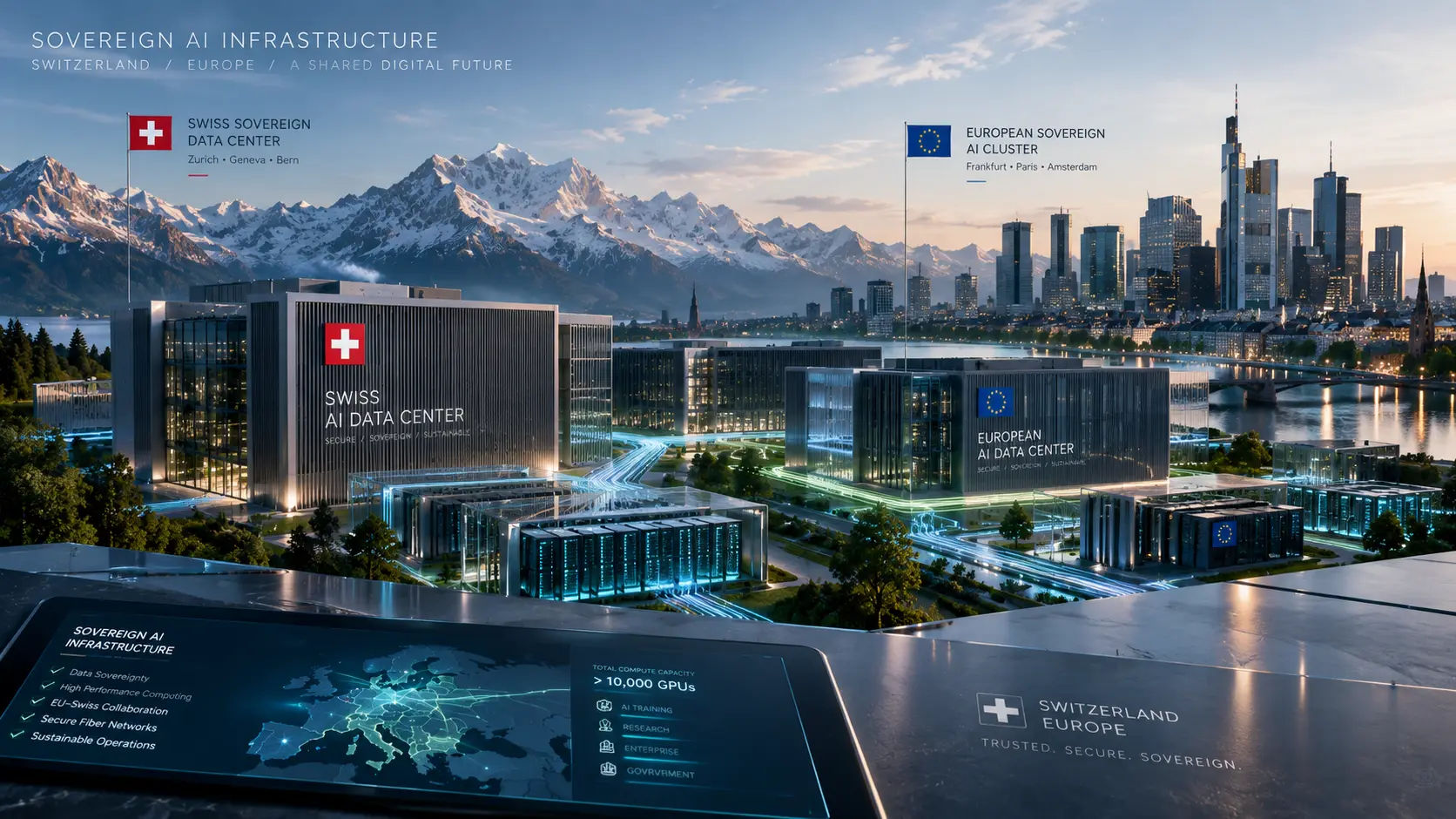
- Enterprise buyers procuring AI services across Switzerland and the European Union face strict data residency, confidentiality, and vendor due diligence mandates under the Swiss revised FADP and EU GDPR.
- Sovereign AI providers in Switzerland (Zurich, Geneva, Zug, Lausanne) and the EU (Frankfurt, Paris, Amsterdam, Dublin) offer robust alternatives to standard US hyperscalers by ensuring data never leaves European legal jurisdictions.
- A compliant enterprise vendor must guarantee Zero-Data Retention (ZDR), verifiable non-training on customer prompts, audited Data Processing Agreements (DPAs), and Swiss-specific SCC addenda where cross-border transfers occur.
- The Swiss AI ecosystem benefits from high-performance academic research hubs (ETH Zurich, EPFL, CSCS) and strong intellectual property safeguards, making it a premier European hub for enterprise privacy-preserving AI.
- Enterprise procurement teams must audit whether AI tools utilize client-side encryption with customer-managed keys (CMEK) and trusted execution environments (Confidential Computing) to prevent foreign intelligence access.
Executive Summary: Navigating Sovereign AI Procurement in Switzerland and Europe
The rapid enterprise adoption of artificial intelligence—spanning Large Language Models (LLMs), automated code assistants, retrieval-augmented intelligence, and predictive decision engines—has revolutionized operational productivity. However, for organizations operating within Switzerland and the European Union, the rush to deploy AI introduces formidable regulatory, contractual, and operational risks.
Under the European Union’s General Data Protection Regulation (Regulation (EU) 2016/679, "GDPR") and Switzerland’s thoroughly modernized Federal Act on Data Protection (revised FADP or "nFADP", SR 235.1), enterprise procurement teams cannot simply license consumer-grade or unvetted AI SaaS tools. Ingesting proprietary business documents, patient health records, banking transaction logs, or customer employee files into untrusted machine learning endpoints risks intellectual property forfeiture, unlawful international data transfers, and severe executive criminal liability under Articles 60–66 nFADP.
Consequently, Tier-1 European enterprises, Swiss private banks, pharmaceutical multinationals, and public sector institutions increasingly demand Sovereign AI: machine learning infrastructure, foundation model endpoints, and vertical AI solutions that operate strictly within European and Swiss jurisdictional boundaries under auditable data protection guarantees.
This market landscape directory and due diligence guide provides enterprise technology leaders, corporate general counsels, and Chief Information Officers (CIOs) with a comprehensive overview of leading AI service providers across Switzerland and the EU, alongside a battle-tested vendor assessment framework for evaluating machine learning compliance.
The Regulatory Due Diligence Framework: Vetting AI Providers for Dual Swiss-EU Compliance
Before executing a commercial licensing agreement or integrating an AI API into production workflows, corporate procurement teams must audit the vendor across four statutory dimensions:
1. Data Residency & Sub-Processor Topography: Exactly where are the physical GPU data centers located? If an AI vendor claims to be "Swiss-based" or "German-domiciled" but routes API inference calls to specialized compute clusters in Northern Virginia or Singapore, a cross-border data transfer has occurred pursuant to Article 16 nFADP and GDPR Article 44. The vendor must provide an immutable list of sub-processors and data center coordinates;
2. Model Training Telemetry Guarantees: Does the vendor harvest customer prompts, completions, or user interactions to train, fine-tune, or calibrate public or proprietary foundation models? Commercial terms must explicitly state that all customer data is quarantined from model training cycles. For a step-by-step engineering walkthrough of zero-retention architectures, consult our practical AI privacy compliance roadmap: how AI providers comply with Swiss FADP and EU GDPR;
3. Execution of the Swiss SCC Jurisdictional Addendum: If the vendor or any of its sub-processors transfers data to the United States or third countries, has the vendor executed the mandatory Swiss Addendum issued by the Federal Data Protection and Information Commissioner (FDPIC)? Furthermore, if transferring to the U.S., is the vendor actively certified under the Swiss-U.S. Data Privacy Framework? As detailed in our comprehensive guide to the Swiss-US Data Privacy Framework vs. EU GDPR: cross-border data transfers for AI systems, certification under the EU-U.S. DPF does not automatically cover Switzerland;
4. Algorithmic Explainability & Human Recourse: If the AI system generates scores or decisions that affect individuals (such as recruitment screening, credit underwriting, or fraud prevention), does the vendor provide feature-level explainability interfaces and human intervention workflows to satisfy Article 21 nFADP and GDPR Article 22?
Key Architectural Pillars of Compliant European AI: ZDR, Data Residency & Weight Isolation
Enterprise-grade artificial intelligence providers in Europe differentiate themselves through rigorous technical and architectural isolation. When evaluating vendors, engineering leads should look for three core architectural pillars:
• Zero-Data Retention (ZDR) APIs: The provider processes prompt inputs and model completions purely in volatile GPU high-bandwidth memory (HBM), purging all data immediately upon socket termination. Persistent logging is restricted exclusively to anonymized system health telemetry and token volume counters;
• Retrieval-Augmented Generation (RAG) Over Fine-Tuning: Advanced providers decouple generalized model weights from mutable corporate data. Instead of fine-tuning foundational models on proprietary client datasets—which risks memorization and model inversion attacks—the vendor utilizes stateless foundation models paired with client-side encrypted vector databases. This ensures that the "right to be forgotten" under GDPR Article 17 and Swiss nFADP Article 32 can be executed instantly by purging the underlying vector index without costly model retraining;
• Confidential Computing Enclaves: The vendor executes inference inside hardware-enforced Trusted Execution Environments (TEEs), such as AMD SEV-SNP or NVIDIA Hopper Confidential Computing enclaves. In this architecture, memory is encrypted at the silicon level, guaranteeing that even cloud hosting engineers, root system administrators, or foreign intelligence agencies cannot inspect data while it is actively being computed.
Categorized Directory of AI Service Providers in Switzerland & EU GDPR Jurisdictions
The following directory profiles leading artificial intelligence service providers, foundation model laboratories, sovereign cloud platforms, and enterprise intelligence vendors operating with robust European and Swiss compliance frameworks.
1. Tier-1 Sovereign Cloud & GPU Infrastructure Hosts
These providers supply the underlying high-performance compute, bare-metal GPU clusters, and managed model-serving environments located physically within Swiss and EU borders:
2. European & Swiss Foundation Model Laboratories
These frontier research laboratories and software vendors build open-weights foundation models, sovereign multilingual LLMs, and enterprise-grade inference APIs:
3. Specialized Enterprise Search, RAG & Vector Intelligence Providers
These software providers develop Retrieval-Augmented Generation (RAG) engines, vector databases, and enterprise knowledge search tools engineered for complex regulatory environments:
4. Vertical Compliance, Legal & RegTech AI Solutions
These vendors deploy specialized machine learning tools designed specifically to navigate statutory compliance, contract intelligence, and corporate governance:
The Enterprise Vendor Assessment Scorecard: 10 Critical Due Diligence Criteria
To ensure rigorous consistency during technical and legal procurement reviews, corporate buying committees should evaluate prospective AI vendors against this ten-point weighted scorecard.
| Criteria # | Evaluation Dimension | Required Enterprise Standard | Statutory Verification Target |
|---|---|---|---|
| 1. Data Residency | Physical Location of Inference Clusters | Primary and backup servers must reside within Switzerland or the EU/EEA. | Art. 16 nFADP / Art. 44 GDPR |
| 2. Model Training | Quarantine of Customer Prompts | Zero retention for model training; contractually barred from foundational retraining. | Art. 6 nFADP / Art. 5 GDPR |
| 3. Zero Retention | Ephemeral RAM Processing | Prompts purged immediately upon session completion; transient cache TTL < 24 hours. | Art. 7 nFADP / Art. 25 GDPR |
| 4. Encryption & Keys | Data at Rest and in Transit | TLS 1.3 in transit; AES-256 at rest with Customer-Managed Keys (CMEK) option. | Art. 8 nFADP / Art. 32 GDPR |
| 5. Contractual DPA | Data Processing Agreement | Executed DPA with GDPR Art. 28 terms and mandatory Swiss Jurisdictional Addendum. | Art. 9 nFADP / Art. 28 GDPR |
| 6. Sub-Processors | Third-Party Transparency | Exhaustive list of sub-processors; 30-day prior written notice before onboarding. | Art. 9(3) nFADP / Art. 28(2) GDPR |
| 7. Explainability | Algorithmic Feature Transparency | Feature-importance metrics available for automated decision-making and scoring. | Art. 21 nFADP / Art. 22 GDPR |
| 8. Human Recourse | Human-in-the-Loop Workflow | Documented operational SLA allowing users to challenge automated model outputs. | Art. 21(2) nFADP / Art. 22(3) GDPR |
| 9. Security Audits | Independent Certifications | Active SOC 2 Type II, ISO/IEC 27001, and ISO/IEC 42001 (AI Management System). | Industry Best Practice |
| 10. Regulatory Shield | Immunity from Foreign E-Discovery | Data insulated from US CLOUD Act access via encryption or European ownership. | Schrems II Jurisprudence |
Contractual Essentials: DPAs, Swiss SCC Addenda, and Confidentiality Guarantees
Executing an AI vendor contract requires moving beyond standard terms of service (Terms of Use). Consumer "click-wrap" agreements universally allow the vendor to harvest user inputs for product improvement and disclaim all liability for inaccurate outputs or regulatory fines.
Enterprise contracts must incorporate three non-negotiable legal exhibits:
1. The Custom Data Processing Agreement (DPA): Pursuant to Article 9 nFADP and GDPR Article 28, the DPA must legally bind the vendor to process personal data strictly in accordance with documented instructions from the controller. It must prohibit the vendor from utilizing prompt context for internal analytics, require immediate assistance with Data Protection Impact Assessments (DPIAs), and mandate breach notification within 24 to 48 hours;
2. The FDPIC Swiss Jurisdictional Addendum: If the AI vendor is incorporated abroad or utilizes international sub-processors, executing vanilla European Commission Standard Contractual Clauses (SCCs) is legally defective. The contract must append the official Swiss Addendum published by the Federal Data Protection and Information Commissioner, explicitly stating that references to the GDPR include the Swiss nFADP, that the FDPIC is the competent supervisory authority, and that Swiss courts possess jurisdiction to hear claims from Swiss residents;
3. Professional Secrecy & Banking Confidentiality Clauses: In Switzerland, companies operating in financial services, wealth management, and healthcare must ensure that vendors sign formal undertakings adhering to Swiss banking secrecy (Article 47 of the Swiss Banking Act, BankG) and professional secrecy (Article 62 nFADP / Article 321 of the Swiss Criminal Code). Violating professional secrecy triggers personal criminal liability for corporate officers.
Risk Mitigation: Preventing Shadow AI, Prompt Leakage & Accidental Transfers
Even with certified AI vendors under contract, corporate compliance remains vulnerable if internal employees utilize unapproved, consumer-grade AI tools on enterprise devices—a phenomenon known as Shadow AI.
When an employee pastes confidential customer data into a free public chatbot to draft a customer email or analyze a financial spreadsheet, that data is transmitted across international borders and ingested into public training models. This constitutes an immediate data breach and an unlawful international transfer.
Recommended Enterprise Mitigation Controls:
• Centralized Enterprise AI Gateway: Deploy an internal API proxy that routes all corporate AI requests through a single, authenticated enterprise portal. Block direct employee access to consumer AI endpoints at the corporate firewall level; • Automated Edge Data Sanitization: Implement client-side Data Loss Prevention (DLP) proxies that inspect outbound prompts before transmission, automatically masking social security numbers, banking IBANs, names, and confidential trade secrets; • Internal Acceptable Use Policies (AUP): Establish clear corporate guidelines defining which categories of data can be processed by approved AI tools, conducting mandatory training regarding executive criminal liability under Swiss law as explored in our report on Swiss FDPIC vs. EU GDPR penalties: criminal fines against individuals vs. corporate sanctions.
Frequently Asked Questions: AI Provider Due Diligence & Market Selection
The following inquiries represent key operational and commercial questions posed by enterprise technology leaders evaluating European and Swiss AI providers.
1. Can a Swiss or EU company legally use US-hosted AI APIs like OpenAI or Anthropic?
Yes, provided specific contractual and operational safeguards are in place. For commercial enterprise tiers, both OpenAI and Anthropic maintain active certifications under the Swiss-U.S. Data Privacy Framework, offer enterprise Zero-Data Retention (ZDR) agreements, and execute Data Processing Agreements with the mandatory Swiss SCC Addendum. However, organizations in banking, defense, and healthcare frequently opt for European-hosted models to eliminate US CLOUD Act exposure.
2. What is the compliance difference between open-weights models and proprietary cloud APIs?
Open-weights models (such as Mistral 7B or Llama) can be downloaded and hosted entirely within your own sovereign, air-gapped on-premise servers or private Swiss cloud instances. In this deployment model, zero data is transferred to third-party vendors, eliminating cross-border transfer risks. Proprietary cloud APIs (such as Mistral Large or GPT-4o) require sending prompt tokens to the vendor’s infrastructure, requiring formal DPAs and transfer due diligence.
3. Does the European Union AI Act apply to AI service providers based in Switzerland?
Yes, if their AI systems are placed on the market in the EU, put into service in the EU, or if the outputs produced by the system are used in the EU (Article 2(1) EU AI Act). A Swiss AI provider selling software to German, French, or Italian clients must comply with the EU AI Act’s product safety, transparency, and risk classification rules.
4. How do I formally verify an AI vendor’s Swiss-U.S. Data Privacy Framework status?
Visit the official U.S. Department of Commerce Data Privacy Framework website (dataprivacyframework.gov), navigate to the public participant search list, search for the vendor’s legal corporate entity name, and confirm that the status for the "Swiss-U.S. Data Privacy Framework" explicitly shows as "Active."
Julian Vance has spent 18 years counseling Fortune 500 AI platforms and multinational financial groups on compliance with Swiss FADP, EU GDPR, and cross-border data transfer mechanisms.
Further Recommended Readings from Our Desks
100 Day Dream Home Lawsuit: Legal Claims, Construction Contract Disputes & Case Details
An In-Depth Legal Analysis of Reality Television Construction Litigation, Accelerated Building Timelines, Breach of Contract Allegations, and Contractor Liability
Swiss FDPIC vs. EU GDPR Penalties: Criminal Fines Against Individuals vs. Corporate Sanctions
A Comparative Legal Analysis of Supervisory Enforcement Powers, Cantonal Criminal Prosecutions of Executives, and European Administrative Turnover Penalties
Swiss FADP vs. EU GDPR: Core Legal Differences, Principles & Requirements Explained
A foundational legal analysis examining the core philosophical doctrines, statutory principles, consent standards, and governance requirements that distinguish Swiss data protection law from the EU GDPR.