
Early Education Franchise Guide: Startup Costs, Top Childcare Brands & ROI
The definitive institutional guide to early childhood education and preschool franchises: Item 7 real estate startup costs, top brand financial metrics, state regulatory ratios, and franchisee ROI.

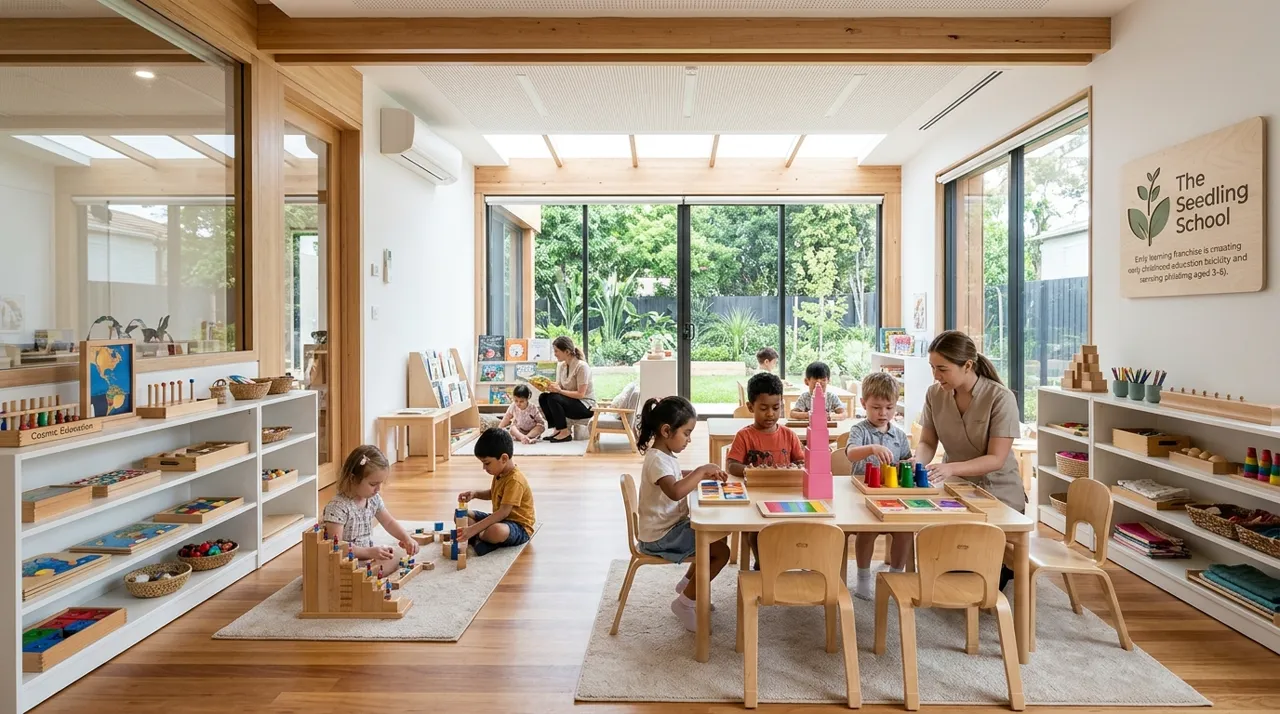
- Investing in an early education franchise represents a high-barrier, capital-intensive asset class with total initial investments ranging from $850,000 to over $4,500,000 depending on leasehold versus fee-simple real estate.
- The sector benefits from powerful macroeconomic fundamentals: rising dual-income households, federal childcare subsidies (CCDF), corporate employer childcare stipends, and inelastic parental demand for premium curriculum.
- Leading brands—including The Goddard School, Primrose Schools, Kiddie Academy, Lightbridge Academy, and Children’s Lighthouse—report average gross revenues between $1.6M and $2.8M per mature school with healthy unit-level EBITDA margins.
- Operational success is dictated by strict state regulatory compliance: mandated teacher-to-child ratios, lead educator credentialing, fire safety egress, background clearances, and child-safe playground surfacing.
- Franchisee financial returns combine high cash-on-cash yields (18% to 28% once licensed capacity exceeds 85%) with long-term real estate equity appreciation for owners who purchase and construct their commercial facilities.
1. Macroeconomic Tailwinds: Why the Early Childhood Education Sector Is Booming
The early childhood education and commercial childcare sector in North America has transformed from a fragmented, mom-and-pop landscape into an institutionalized, multibillion-dollar asset class. Driven by irreversible socioeconomic demographic shifts, modern parents do not view early learning as a custodial luxury or babysitting convenience; it is perceived as an essential developmental prerequisite for lifelong academic achievement.
Multiple macroeconomic tailwinds converge to sustain high, recession-resilient demand across suburban and metropolitan markets:
• The Rise of Dual-Career Households: Over 68% of married-couple families with children under the age of six feature both parents participating in the formal labor workforce. Quality infant care and preschool education are non-negotiable operational requirements for dual-earning households.
• Substantial Federal & Corporate Subsidies: The modern regulatory climate actively channels capital toward early learning infrastructure. Programs such as the federal Child Care and Development Fund (CCDF) alongside corporate employee benefits (e.g., pre-tax Dependent Care Flexible Spending Accounts and employer-sponsored childcare vouchers) subsidize tuition, ensuring dependable enrollment cash flow.
• Sticky Multi-Year Customer Lifetime Value (LTV): Unlike retail or hospitality where customer retention is volatile, an infant enrolled in an early education franchise frequently remains with the school for four to five consecutive years—progressing through toddler classes, preschool, pre-kindergarten, and after-school enrichment before entering kindergarten. With average annual tuition ranging between $14,000 and $24,000 per child, a single enrolled infant generates over $75,000 in gross lifetime tuition revenue.
• Demographic Insensitivity to Inflation: Parents routinely cut back on dining out, discretionary apparel, and vacation travel during economic contractions while tenaciously protecting their children’s educational tuition. This makes premium early learning systems exceptionally defensive assets during broader economic downturns.
• The Failure of Independent Providers to Meet Modern Standards: Historically, independent home-based or church-affiliated daycares dominated local childcare. However, modern millennial and Gen-Z parents demand strict biometric access security, closed-circuit video streaming, STEAM-based accredited curricula, organic nutritional programs, and transparent parent-teacher communications apps. Independent operators lack the capital to install $100,000 security and technology stacks, directly funneling affluent parent demand into nationally recognized corporate franchise systems.
2. Item 7 Startup Costs & Real Estate Capital Expenditure Breakdown
Prospective franchisees must recognize that an early education franchise is a capital-intensive commercial endeavor. Unlike home-based businesses or mobile trade vans, opening a modern 10,000-to-15,000-square-foot preschool facility requires sophisticated civil engineering, substantial tenant improvements, and stringent architectural compliance.
Under the Federal Trade Commission (FTC) Franchise Disclosure Document (FDD), Item 7 outlines the total estimated initial investment. These costs diverge significantly based on whether the franchisee pursues a Leasehold Buildout Model or a Turnkey / Ground-Up Real Estate Development Model:
1. Initial Franchise Fee ($40,000 – $75,000)
Paid immediately upon execution of the franchise agreement, granting territorial rights, proprietary proprietary STEAM/Montessori curriculum licenses, architectural prototype blueprints, and pre-opening corporate training programs.
2. Real Estate Site Selection, Leasehold Improvements & Architecture ($500,000 – $2,200,000)
The single largest budget allocation. If leasing a commercial space, converting it into a certified preschool involves framing multiple age-segregated classrooms, installing low-height commercial plumbing and sinks, soundproofing walls, installing secure magnetic biometric keycard access systems, and laying commercial antimicrobial flooring.
3. Outdoor Playground Equipment & Impact Surfacing ($80,000 – $250,000)
State childcare licensing boards enforce strict square-footage mandates for outdoor recreation (typically 75 square feet of outdoor play space per child outdoors at any given time). Equipment must feature commercial shade structures, ADA-accessible ramps, security perimeter fencing (minimum 6 feet height), and poured-in-place rubber or turf safety surfacing certified to ASTM critical fall height standards.
4. Classroom Furniture, Fixtures & Equipment (FF&E) ($120,000 – $280,000)
Outfitting 8 to 12 individual classrooms with age-appropriate hardwood tables, ergonomic child chairs, cribs for infant suites, developmental sensory tables, interactive smart boards, and certified pedagogical toys.
5. Technology, Security Cameras & Classroom Management Systems ($35,000 – $85,000)
Modern parents demand real-time streaming video access to their child’s classroom. Franchisees must install closed-circuit HD security camera arrays, secure parent mobile portals, automated billing software, and electronic staff check-in kiosks.
6. Working Capital & Operating Deficit Reserves ($150,000 – $350,000)
Childcare facilities experience an initial "fill-up ramp" lasting between 9 and 18 months before reaching cash-flow breakeven (typically 65% to 70% licensed capacity). FDD Item 7 mandates sufficient liquid operating reserves to cover payroll, facility rent, and marketing during this ramp-up phase.
3. Top 5 Early Education Franchises: Comparative Financials & System Benchmarks
Selecting the right franchise brand requires forensic analysis of system size, royalty overhead, average unit volume (AUV), and Item 19 financial performance representations. The comparative matrix below outlines key data points across the five dominant national early education franchise systems:
| Franchise System | Year Founded / Units | Initial Franchise Fee | Royalty / Ad Fund | Total Estimated Investment (Item 7) | Reported Average Gross Sales (AUV) |
| :--- | :--- | :--- | :--- | :--- | :--- |
| The Goddard School | 1988 / 600+ units | $60,000 | 7.0% royalty + 4.0% ad fund | $950,000 – $4,200,000 | $2,310,000 (Top quartile exceeds $3.1M) |
| Primrose Schools | 1982 / 500+ units | $80,000 | 7.0% royalty + 2.0% ad fund | $1,100,000 – $4,500,000 | $2,540,000 (Balanced preschool/infant model) |
| Kiddie Academy | 1981 / 320+ units | $65,000 | 7.0% royalty + 2.0% ad fund | $1,050,000 – $4,800,000 | $2,180,000 (Flexible real estate formats) |
| Lightbridge Academy | 1997 / 150+ units | $40,000 | 7.0% royalty + 2.0% ad fund | $850,000 – $3,900,000 | $1,950,000 (Strong East Coast/Mid-Atlantic footprint) |
| Children’s Lighthouse | 1995 / 70+ units | $50,000 | 7.0% royalty + 2.0% ad fund | $900,000 – $3,800,000 | $1,820,000 (Character-based proprietary curriculum) |
Architectural & Pedagogical Nuances Across Top Systems
• The Goddard School: Renowned for its proprietary F.L.EX. Learning Program (Fun Learning Experience), Goddard empowers certified teachers to customize lesson plans based on individual student curiosity. Their corporate support features dedicated Education Directors who mentor on-site directors, ensuring accreditation through Cognia.
• Primrose Schools: Positions itself as the premier national brand for school readiness. Its proprietary Balanced Learning curriculum blends purposeful play with teacher-guided instruction, emphasizing character development. Primrose centers frequently command the highest average tuition rates in their respective submarkets.
• Kiddie Academy: Known for exceptional operational flexibility in facility design, Kiddie Academy excels in both suburban freestanding buildings and high-density urban ground-floor mixed-use retail spaces. Their "Life Essentials" curriculum focuses heavily on STEM concepts, character education, and health and fitness.
• Lightbridge Academy: Branded as "The Solution for Working Parents," Lightbridge distinguishes itself through innovative operational conveniences: extended operating hours, biometric facial recognition entry, interactive whiteboard technology, and the Lightbridge Journey app, which live-streams milestones and photos to parents.
• Children’s Lighthouse: Focuses heavily on character-based early learning with its Lighthouse C.A.R.E.S. curriculum. Their architectural prototypes emphasize spacious, brightly lit classrooms and expansive natural outdoor discovery playgrounds.
Understanding these distinctions is essential. As covered in our foundational analysis of franchisor vs franchisee legal rights and commercial agreements, royalty obligations are calculated on top-line gross receipts, meaning your center pays royalties regardless of whether you have achieved unit-level profitability. Careful territory mapping via evaluating local franchise opportunities near you and territorial demographics ensures you select an affluent submarket capable of supporting premium tuition rates.
4. Regulatory Compliance, Teacher-to-Child Ratios & State Licensing Mazes
No sector in commercial franchising—aside from perhaps specialized healthcare or pharmaceutical distribution—faces the intense regulatory scrutiny imposed on early childhood education centers. Every single state enforces statutory administrative codes administered through departments of human services, public health, or early childhood education.
Mandated Teacher-to-Child Ratios
Ratios dictate your school’s direct labor costs and physical capacity limits. While specific statutes vary by state, standard national guidelines mandate strict educator-to-child staffing thresholds:
• Infants (6 weeks to 12 months): Typically 1:3 or 1:4 with a maximum group size of 8. Infant suites are labor-intensive, requiring high staffing overhead but serving as the essential customer acquisition funnel for older classrooms.
• Toddlers (12 to 24 months): Typically 1:5 or 1:6 with a maximum group size of 12.
• Preschool (3 to 4 years old): Typically 1:10 or 1:12 with a maximum group size of 20.
• Pre-Kindergarten & School-Age (5+ years): Typically 1:15 to 1:20.
Violating these ratios—even for fifteen minutes during an educator’s lunch break—can trigger state citations, suspension of operating licenses, and devastating public disclosure on state licensing registries. Experienced operators maintain a 10% to 15% staffing redundancy buffer of floating substitute teachers to ensure continuous compliance.
Facility Egress, Sanitation & Director Qualifications
State inspectors rigorously audit building specifications. Facilities must feature secondary fire egress doors in every classroom directly accessing the exterior, panic hardware, dedicated diaper-changing sanitation stations with non-porous hands-free sinks, and comprehensive background finger-printing (FBI/DOJ clearances) for every staff member. Crucially, state laws require that the on-site Center Director possess specific collegiate credentials—such as a Master’s or Bachelor’s degree in Early Childhood Education (ECE) alongside documented clock hours of childcare administrative leadership.
5. Unit Economics, Capacity Utilization, and Realized Franchisee ROI
To evaluate the financial viability of an early education franchise, one must understand how unit economics scale with student enrollment. Unlike service franchises such as Massage Envy franchise startup costs, royalty fees, and unit economics where labor is commissioned per treatment hour, a preschool facility incurs heavy fixed real estate overhead that converts into massive operating leverage once breakeven is passed.
Enrollment Sensitivity Analysis: Breakeven vs. Full Capacity
The financial trajectory of an early learning center is governed entirely by enrollment thresholds:
• 0% to 60% Capacity (Ramp Phase): The school operates at a temporary monthly cash deficit. Fixed rent and administrative leadership salaries are incurred, but tuition volume is insufficient to offset direct classroom educator payroll.
• 65% to 70% Capacity (Breakeven Milestone): Typically achieved between month 9 and month 15. All facility occupancy, debt service, curriculum fees, and operational payroll are fully covered by incoming tuition collections.
• 75% to 90% Capacity (The Profit Acceleration Zone): Every additional student enrolled drops almost 70% of gross tuition straight to the bottom line (EBITDA), because facility rent is already paid and staffing ratios for existing classrooms absorb the incremental child without triggering additional teacher hires.
The Anatomy of a Mature Preschool Income Statement (175 Licensed Capacity)
Consider an executive modeling benchmark for a center licensed for 175 children operating at 85% capacity (148 enrolled children) with an average blended monthly tuition of $1,450 per child:
• Gross Annual Tuition Revenue: $2,575,200 (148 children × $1,450 × 12 months)
• Direct Labor & Employee Benefits (42%–48%): $1,158,840 (Center Director, Assistant Director, Lead Teachers, Float Staff, Health Benefits, Payroll Taxes)
• Facility Occupancy / Commercial Lease (12%–16%): $360,000 ($30,000/month triple-net commercial lease)
• Franchise Royalties & Ad Funds (9%): $231,768 (7% Royalty + 2% National Brand Fund)
• Food Program, Supplies & Curriculum Materials (5%): $128,760 (Catered organic meals, art supplies, pedagogical workbooks)
• Insurance, Utilities & Maintenance (4%): $103,000 (Commercial general liability, workers' comp, HVAC, playground sanitization)
• Local Marketing & Parent Retention (2%): $51,504 (Local digital campaigns, community open houses, and implementing the art of writing thank you for your business notes and parent retention)
• Net Operating Income (EBITDA): $541,328 (~21.0% Net EBITDA Margin)
For an owner-operator who invested $1.2M in equity and financed the remainder via an SBA 7(a) loan, an annual free cash flow of $350,000 (after debt service) delivers an extraordinary cash-on-cash return of nearly 30% per annum.
6. The Due Diligence Roadmap: FDD Audits, Validation Calls & SBA 7(a) Execution
Navigating the acquisition of an early education franchise demands institutional-grade due diligence. Prospective owners should execute a structured four-stage evaluation playbook:
1. Forensic Item 19 & Item 20 Analysis
Examine FDD Item 19 to determine what percentage of operational units achieve the reported average gross sales. Is the average skewed by a handful of massive mega-centers? Scrutinize Item 20 for franchise turnover: how many units were transferred, terminated, or ceased operations over the preceding three fiscal years? A cessation rate exceeding 3% warrants deep investigation.
2. Conduct Exhaustive Franchisee Validation Calls
The franchisor will furnish a contact list of all existing franchisees in FDD Item 20. Call at least 15 to 20 active owners across varying markets. Inquire about actual ramp-up timelines: "Did you reach cash flow breakeven in 12 months or did it take 24 months?", "What is your annual staff turnover rate among lead teachers?", and "How supportive was corporate during site selection and local municipal zoning hearings?"
3. Securing SBA 7(a) & SBA 504 Real Estate Financing
Because initial capital requirements frequently exceed $1.5M, most franchisees secure financing through the U.S. Small Business Administration (SBA). The SBA 7(a) loan program provides guarantees up to $5,000,000, typically requiring 15% to 25% cash down from the borrower. For franchisees purchasing the underlying real estate, the SBA 504 loan structure is exceptionally attractive, offering 90% loan-to-value financing with 25-year fixed interest rates.
4. Cultivating Trust & Parent Communication Excellence
Ultimately, early education is a business of radical empathy and sacred trust. Applying lessons from enterprise customer experience consulting, NPS optimization, and brand standards, visionary owners create transparent, welcoming cultures that treat parents as collaborative partners in their child’s intellectual and emotional foundation.
By pairing a proven educational curriculum with rigorous financial underwriting and passionate community stewardship, an early education franchise represents one of the most rewarding and economically resilient investments in the contemporary commercial enterprise landscape.
Frequently Asked Questions
How much total liquid capital do I need to qualify for an early education franchise?
Most top-tier preschool franchise systems (such as Primrose Schools or The Goddard School) require prospective franchisees to demonstrate a minimum of $500,000 to $750,000 in unencumbered liquid capital (cash, stocks, money market accounts) and a minimum personal net worth of $1.5M to $2.5M to qualify for underwriting and commercial real estate guarantees.
Do I need a background in teaching or education to own a preschool franchise?
No. The vast majority of early education franchise owners are corporate executives, finance professionals, or multi-unit entrepreneurs. The franchisor’s operational model requires you to hire a fully certified on-site Center Director who holds the statutory state early childhood education degrees and licenses to manage daily curriculum and educator compliance.
How long does it take from signing the franchise agreement to opening doors?
Due to commercial zoning approvals, architectural design, state licensing inspections, and physical construction, the development cycle typically spans 18 to 28 months for ground-up commercial builds, and 12 to 16 months for existing building retrofits.
What is the average profit margin of a mature childcare franchise?
Mature early education centers operating at 80% to 90% licensed capacity typically generate EBITDA margins between 18% and 25%, resulting in $350,000 to $600,000+ in annual pre-tax net operating income depending on unit capacity and local tuition rates.
Is it better to lease the commercial building or buy the underlying real estate?
Purchasing the real estate via an SBA 504 loan is often the ultimate wealth creation vehicle because your center pays rent to your own real estate holding company, building multimillion-dollar equity over time. However, leasing reduces upfront cash requirements, allowing franchisees to preserve capital for multi-unit territory expansion.
Claire Montgomery is a senior human resources executive and workplace communications analyst with 16 years of enterprise leadership experience guiding corporate culture, internal diplomacy, and team sentiment.
Further Recommended Readings from Our Desks
Pros of a Business Partnership: 8 Big Advantages, Types & Agreement Tips
An executive masterclass on business partnerships: 8 foundational strategic advantages, legal entity structures (GP, LP, LLP, LLC), partnership agreement anatomy, and dispute-proofing protocols.
Youth Entrepreneurship Support Programme: Grants, Mentorship & Funding for Young Founders
The ultimate guide to youth entrepreneurship support programmes: non-dilutive grant capital, top global accelerators, elite mentorship frameworks, and application strategies for founders under 30.
Sole Proprietorship: 15 Real Business Examples, Pros, Cons & Tax Rules
An exhaustive masterclass on sole proprietorships: 15 concrete commercial examples, legal liability mechanics, IRS Schedule C taxation, 199A QBI deductions, and when to graduate into an LLC.